University of Arizona
Project: Scholarship Universe Project lead: Kenneth Downs, senior project coordinator, scholarships and financial aid Technologies used: Developed in-house |
In today's economy, rising education costs and dwindling financial support are making it harder for students to attend college and graduate. To bridge that gap, The University of Arizona designed a new system that helps UA students find scholarships and also streamlines the institution's process for awarding departmental scholarships.
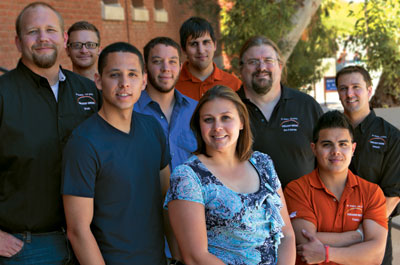
The University of Arizona's Scholarship Universe team |
"The university wanted to give its students a competitive edge," says Kenneth Downs, senior project coordinator of scholarships and financial aid. "We wanted to help students capture limited scholarship dollars, save them time from having to find those dollars, and enable departments to centralize their scholarship programs."
After securing funding from UA's student board, Downs and his team embarked on a yearlong process to develop the new system. Phase one of Scholarship Universe debuted in November 2010. The web-based system matches UA students to scholarships--external and internal--for which they are eligible.
When a student logs into Scholarship Universe for the first time, he is prompted to answer questions that are generated from eligibility requirements of currently available scholarships. The system stores the answers in the student's profile--which can be edited at any time--and uses the data to find suitable matches in the scholarship database. Users see matches only for scholarships that are open for application, and they receive a snapshot of the information needed to apply. In addition, students can track scholarships for which they have already applied. Each time a user logs in, the system shows new matches or new profile questions.
Downs and his team initially explored commercial options and scholarship-matching websites, but ultimately decided to develop Scholarship Universe in-house. "We wanted to tailor the system to our students' needs," says Downs. While most commercial systems collect only basic information, such as GPA, major, and place of birth, UA's system is designed to go deeper into the scholarship requirements.
In fact, Scholarship Universe has no limit on the amount and type of data that it collects. "We can get into certain kinds of memberships, family medical history, parents' employment, and more," explains Downs. "We can get it down nearly as specific as possible." This level of detail provides students with the best scholarship matches, and increases their chances of winning much-needed dollars.
In the first 14 months after the system was launched, 3,767 students used Scholarship Universe to apply for 11,167 external scholarships. Twenty-five percent of those students won scholarships.
Downs' team continually updates Scholarship Universe with new scholarships, all of which are reviewed for availability, accuracy, and legitimacy. The university has reached out to the community to find new scholarships, too, creating focus groups with local high schools to identify the scholarship needs of their students.
Downs credits UA students for much of the project's success. Funding for the project came from the university's student board, which allocates dollars from student fees toward select campus projects. Furthermore, the Scholarship Universe team is made up of UA students, who work on programming, research and data management, and marketing. These students helped build and now maintain the database. By using students, Downs says, the university ensures that the database remains focused on student needs.
UA's project is far from over. Phase two of the project--which includes bringing internal departmental scholarships into Scholarship Universe--is already under way. The university also plans to add an electronic-application function, a résumé and cover letter builder, a robust search engine, and other tools. "Ultimately, we want Scholarship Universe to be a one-stop resource for our students," concludes Downs.
About the Author
Kanoe Namahoe is online editor for 1105 Media's Education Group. She can be reached at [email protected].