Incoming NYU Tandon School of Engineering Students Experience VR-Gaming
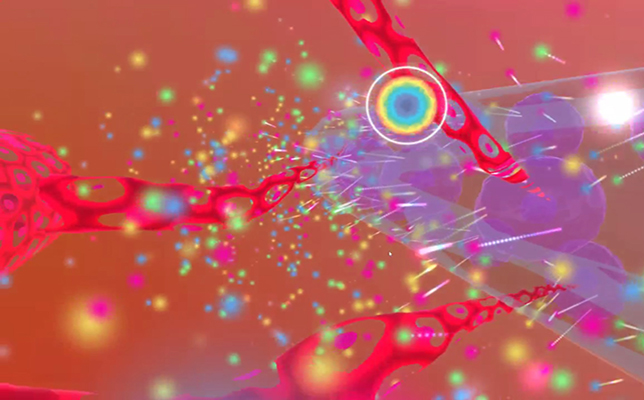
Image Credit: NYU Tandon School of Engineering.
Imagine being able to steer yourself along a capillary the way you would in Need for Speed, or shoot at chemical signals like you would in any first-person shooter game. That’s possible now with a new virtual reality (VR) app from the NYU Tandon School of Engineering that enables users to explore and engage with a microscopic, intracellular world in a game-like environment. The VR experience, called Tandon Labs, is being used as an admissions tool with a simple goal: Attract future engineers and scientists who are hyped about STEM. Tandon Labs debuted at the SXSWedu conference taking place this week in Austin.
Newly admitted students into the NYU Tandon School of Engineering will find a 3D cardboard viewer in their acceptance packages that allows them to experience a VR game environment. Using their cardboard viewer, they can interact with cells that communicate using chemical signals — increasing the speed at which capillaries grow and extend toward bone cells whenever visual cues present themselves in the environment.
Mark Skwarek, artist, lecturer and head of the NYU Mobile Augmented Reality Lab, and Siyuan Qiu, a graduate from the Integrated Digital Media (IDM) program, helped design the app. In addition, R. Luke DuBois, an artist, musician and associate professor who co-directs the program, composed the dreamlike soundtrack, while undergraduate student Simone Brown narrates. The VR experience is based on research by Alesha Castillo, an assistant professor in the Department of Mechanical and Aerospace Engineering.
“Users visit [Castillo’s] Laboratory of Mechanobiology and Regenerative Medicine, where they are virtually dropped through a microscope’s eyepiece to the interstice between bone and capillary-forming endothelial cells,” according to a news release. “They will enjoy a colorful close-up view of the process by which bone cells use chemical signals called paracrines to enjoin capillary endothelial cells to commence angiogenesis — the formation of new blood vessels.”
Notably, IDM is the only program in Tandon in which the majority of faculty and students are women, according to the program’s website.
"Tandon Labs is a great tool for attracting more prospective and newly admitted students," said Elizabeth Ensweiller, director of enrollment management at Tandon, in the news release. "We hope Tandon Labs inspires more underrepresented STEM populations to start their journey with STEM at NYU Tandon School of Engineering."
"It is still not easy for students to find female mentors, so it is critically important that we have more women in the field — and that women have a place at the table," Castillo commented.
The app is compatible with Oculus Rift and Vive and is available to all as a free download for Android and Apple. To learn more, watch the video below. Further information is available on the NYU Tandon School of Engineering site.
About the Author
Sri Ravipati is Web producer for THE Journal and Campus Technology. She can be reached at [email protected].