New U-M Classroom Building Emphasizes Active, Team-Based Learning
- By Kristal Kuykendall
- 12/17/21
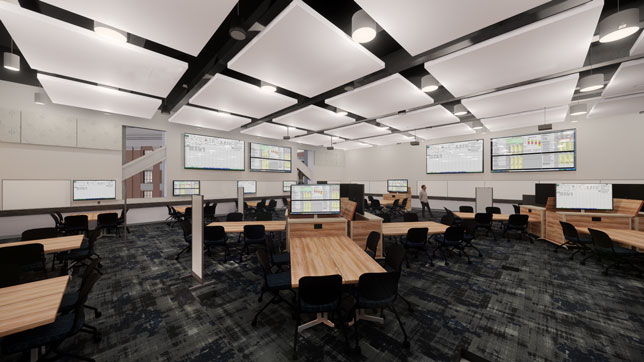
The new Central Campus Classroom Building at University of Michigan includes three Team-Based Learning Classrooms, ranging from 132 seats to 162 seats each, with movable strip tables, movable seating and a collaborative design.
When classes resume for the Spring 2022 semester at the University of Michigan, a new Central Campus Classroom Building will welcome more than 10,000 students per day, the university said this week in a news release.
About 90 undergraduate and graduate classes will be held in the 105,000-square-foot CCCB, which sits at the Central Campus" east entrance.
Plans for the new facility were approved by the U-M Board of Regents three years ago; the CCCB was designed specifically to support "active and team-based learning classrooms," the university said, and particularly for larger classes. The facility has 1,400 seats in seven classrooms of varying room configurations ranging from 100 to 572 seats.
"Our goal is to offer innovative and collaborative experiences in all classes, where students interact with and learn from their instructors as well as each other," said Amy Dittmar, senior vice provost for academic and budgetary affairs. "The CCCB offers a variety of large, modern classrooms that support this type of teaching and learning. We are very excited to welcome instructors and students into the building to transform the teaching and learning experience at such a large scale."
Teaching in the Round
The CCCB's signature space is a 190-seat classroom in the round, providing a 360-degree experience for students. Based on the theater-in-the-round concept, the state-of-the art classroom places the instructor in the center of the room, surrounded by students sitting in rows that form a circle.
Even with 190 seats, the greatest distance between the instructor and students is five rows, creating a more intimate learning environment. The room includes display screens also arranged in a circular pattern, so every student can easily view the instructional content.
U-M is one of only a few institutions in the U.S. that currently have this unique type of classroom, Dittmar said. Others include Oregon State, Washington State and Texas A&M.
Unique features of the CCCB classrooms include:
- Multiple aisles to allow instructors to navigate each classroom easily and connect with students wherever they are;
- Each classroom"s furniture enables students to learn independently and in teams, as needed; and
- Three classrooms have computers installed at every student table, so ideas and student work can easily be shared with the entire class.
At 572 seats, the CCCB"s auditorium will be the largest classroom space on the Ann Arbor campus, yet it too emphasizes active learning and collaboration: The auditorium seating allows students to work with those beside them or turn 180 degrees to work with those behind them. And the large space is configured so that students are, at most, just 13 rows away from the instructor.
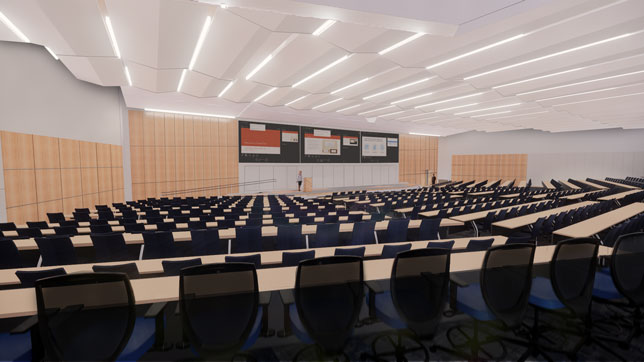
The CCCB"s unique auditorium with 572 seats provides opportunities for instructors and students to engage with each other on a large scale; student seats swivel 180-degrees enabling them to interact with those next to and behind them.
The building also features more than 350 informal seats and whiteboards throughout, providing areas for students to study, collaborate or socialize outside the classroom.
Learn more and view photos of the new facility at the University of Michigan website.
About the Author
Kristal Kuykendall is editor, 1105 Media Education Group. She can
be reached at [email protected].