2007 Campus Technology Innovators: Cellular/Mobile
TECHNOLOGY AREA: CELLULAR/MOBILE
Innovator: Montclair State University
Providing communications and mobile services to a diverse
faculty and student body—the way they want it
Montclair State University, New Jersey's second largest
and fastest-growing university, is committed to service as it
races toward a predicted 18,000-student enrollment for its
2008 centennial. One manifestation of the institution's service
mission is a program called MSU Campus Connect,
which provides communications and mobile services via students'
preferred technology: the cell phone. "As part of their
tuition and fees, all incoming students receive a phone that is
GPS-enabled and bundled with a wide variety of mobile learning,
safety, community, and campus navigation tools," explains
VP for IT Ed Chapel. "The program is designed to help the university
keep on-campus and commuter students engaged,
and improve students' overall living and learning experiences."
The original vision for Campus Connect dates back several
years: It was created as a response to the Student Development
and Campus Life group's reports of student complaints
about unsatisfactory telephony services (an older PBX landline-based
model, with residential students sharing phones in their
rooms). But Chapel and others in the IT office realized that
simply replacing the old landlines with cell phone service wasn't
going to be enough; they looked for opportunities to add
value by building a custom network for the campus—one which
could support a host of cell phone-enabled applications. By
2005, the general availability of high-quality cellular service
made feasible the first implementation of the
Campus Connect program,
which marketed
cell phones to students
as "portable information
kiosks," with about
10 applications. The
Campus Connect program
now leverages the
mobile functionality—
and the immense popularity
and familiarity—of
cell phones by offering to
the campus community an
array of applications for
academics, social networking,
SMS and RSS services,
GPS, and text-alerting capabilities.
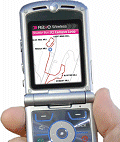
Technology choices. The Campus Connect implementation
forged partnerships with Sprint Nextel for telephone services, and Rave Wireless for applications development and vendor relationship management.
MSU's Office of Information Technology delivers
technology support. The current mobile phones—Motorola, Samsung, Sanyo, and LG handsets—
are offered on the Sprint and Nextel networks, and provide
specific data options that allow unlimited access to the
software applications developed by the university, in collaboration
with Rave Wireless.
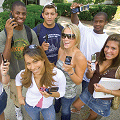
INCOMING STUDENTS AT MSUreceive a GPS-enabled
mobile phone bundled with a
wide variety of mobile
learning,safety, community,
and campus navigation tools.
Upon enrolling in the Campus Connect program, students
create a profile online and select the resources they want to
receive on their phones (the resources are available via a combination
of text messaging, GPS-enabled location-based services,
and the mobile internet). The Campus Connect phones
are centrally supported to ensure training and support are
consistently provided to all students. Students receive additional
benefits from the program (such as no contract requirements
or activation/break fees), plus they can port their own
mobile phone numbers to their Campus Connect phones.
Montclair State leverages the mobile phone to
improve communication, build community, and increase
access to campus application and services.
Continuing expansion. Currently, more than 3,000 students
are participating in the Campus Connect program, a figure
that will double in the upcoming academic year. There's now
a long and growing list of applications offered, and usage of the
phones extends to the classroom, where their direct-response
capability allows for instant polling on surveys and quizzes. Students
are using the devices for academics in myriad ways:
downloading course announcements, sending text messages to
professors, or accessing information that was digitally tagged
during a lecture, for instance. The most visible campuswide
applications include sending broadcast text messages in the
event of a weather emergency; providing access to MSU e-mail,
student, and staff directories; creating university groups where
members can participate in group text messaging and polls; and
an acclaimed Mobile Guardian feature that incorporates a GPS
tracking system as a "virtual escort" a student can employ if he
or she doesn't feel safe. Chapel comments on the continuing
expansion of Campus Connect applications: "From a university
perspective, we leverage the mobile phone to improve communication,
build community, and increase access to and usage of
all of our campus applications and services."