CT Briefs
:: NEWS
SEARCHING THE VIDEO
LECTURE. Researchers at MIT's
Computer Science and Artificial Intelligence
Laboratory (CSAIL) have
developed a prototype search function
for classroom video recordings available
online through the university's
OpenCourseWare initiative. The system
analyzes a transcript of each video
lecture created with speech recognition
software. "Our goal is to develop
a speech and language technology that
will help educators provide structure
to these video recordings, so it's easier
for students to access the material,"
explains James Glass, head of CSAIL's
Spoken Language Systems Group.
Read more here.
TOP-FLIGHT SECURITY.
Embry-Riddle Aeronautical University (FL) is implementing the Oracle Identity and Access
Management Suite as a foundation for
its identity management infrastructure,
to secure a wide variety of data and
applications accessed via 60,000-plus
faculty, staff, affiliate, student, alumni,
and applicant accounts. With
the Oracle Identity Manager
suite component already in
place, the university will
move to the next phase of
its rollout—Oracle Access
Manager, which will provide
an improved, centralized single
sign-on system throughout
Embry-Riddle's IT
infrastructure.
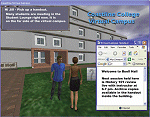
STUDENT AVATARS meet with peers on Coastline Community College's 3D computer-generated campus.
VIRTUAL CAMPUS
DEVELOPMENT. The
Instructional Systems Development
(ISD) team at Coastline
Community College (CA) recently debuted its new virtual
college technology, where student
avatars explore a 3D computergenerated
campus and meet with their
peers online. Dan Jones, executive
dean of ISD, hopes the team's work
will "revolutionize our concept of
education."
STAYING ALERT. George Washington
University (DC) is deploying
GW Alert, a new system on campus
that can generate text messages which
crawl across the bottom of a PC screen
to inform users about emergency situations.
The security application, from
BIA Information Network, can also provide
graphical messages and web links for
additional help.
FEELING SMART AT NOVA
SOUTHEASTERN. A new Shark
Card has been issued to more than
25,000 students, faculty, and staff at
Nova Southeastern University (FL),
incorporating both contact and RFID-enabled
smart chips, plus biometrics.
The technology, from SmartCentric
Technologies International, will provide a
range of services to the campus community
on a single card. Benny
Mohall, NSU's director of projects,
systems, and technical support, comments
that the new cards offer
"a platform for rapid expansion well
into the future." Read more here.
TERAGRID CENTERS. The
National Science Foundation recently awarded grants to
five high-performance computing
centers for their participation in
TeraGrid, a nationwide
research infrastructure that
encompasses HPC resources. For the
prestigious awards, NFS selected
Purdue University (IN), the
Louisiana Optical Network Initiative based at Louisiana
State University, the National Center
for Supercomputing Applications at the University
of Illinois, the San Diego Supercomputer
Center (www.SDSC.edu)
based at the University of California-
San Diego, and the Texas Advanced
Computing Center at The University of
Texas-Austin.
:: PEOPLE
 BLOGGING ANALYST. In his new
book, Blogging America: The New
Public Sphere (Praeger, November
2007), Aaron Barlow, an assistant
professor of English
at NYC College
of Technology, has
taken on the many
complexities of
blogging, including
the changing attitudes
toward communications
technologies and, yes, even college
students' writing. Read more here.
BLOGGING ANALYST. In his new
book, Blogging America: The New
Public Sphere (Praeger, November
2007), Aaron Barlow, an assistant
professor of English
at NYC College
of Technology, has
taken on the many
complexities of
blogging, including
the changing attitudes
toward communications
technologies and, yes, even college
students' writing. Read more here.