NEC Intros 11,000-Lumen, 3-Chip Large Venue Projector
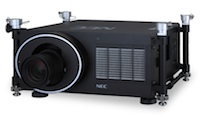
The NEC PH1000U offers a native WUXGA resolution and produces 11,000 lumens of brightness. |
NEC has unveiled a new high-light-output HD projection system designed for large venues with high levels of ambient light.
The PH1000U is built around three 0.96-inch DLP chips and uses redundant dual Ultra High Performance lamps to produce a light output of 11,000 lumens with a 2,000:1 contrast ratio at a native resolution of 1,920 x 1,200 (WUXGA). It can also be stacked with additional units to produce a brightness of up to 44,000 lumens.
The projector is also networkable via wired or optional wireless LAN and supports Windows Network Projector, Remote Desktop, Network Drive, and Media Connection functions.
Other features include:
- Card slot supporting Intel's Open Pluggable Specification;
- Closed captioning support;
- Edge blending for combining projectors to create larger panoramas;
- Designed for continuous operation;
- ±30 degree vertical keystone correction and ±35 degree horizontal keystone correction;
- Geometry correction for projecting on curved or angular surfaces;
- Five optional bayonet-style lenses with power zoom, focus, and shift (±20 percent horizontal shift, +50 percent/-40 percent vertical);
- Carbon savings meter;
- Wall color correction;
- DDC/CI support;
- DICoM simulation mode;
- Projection distance of 1.8 feet to as much as 243 feet;
- Lamp life of up to 2,500 hours in economy mode; and
- Security features ranging from anti-theft lens screw and cabinet lock to password protection and Kensington lock slot.
The installation projector weighs in at 87.1 pounds and measures 22.7" (w) x 9.3"(h) x 22" (h).
AV inputs include HDMI, 5BNC, dual RGB (mini D-sub 15-pin), DisplayPort, S-video, and composite. Outputs include monitor out (mini D-sub 15-pin) and variable audio.
The PH1000U is expected to be available beginning in October for $49,999 without a lens. Education and Star Student users can receive an extended warranty on the system beyond the base three-year warranty on parts and labor. More details can be found on the Star Student site or on necdisplay.com.