New LMS Promotes Cross-Institutional Work
- By Dian Schaffhauser
- 11/01/11
An international team backed by the European Union and based out of Berlin has introduced a new, free, dual-language learning management system with a large dose of collaboration functionality built in. iversity, a cloud-based offering, introduces the concept of "social reading" along with more familiar features.
The company, which goes by the same name, reported that iversity has been beta-tested by 11,500 students and faculty members from 80 colleges and universities. During that time a team of 20 young graduates from the United States, the United Kingdom, France, Germany, Singapore, and other countries have rebuilt the platform to address user feedback.
The application has a simple interface with a focus on allowing users to exchange learning materials, connect with peers, and hold online group discussions. Users can:
- Organize research groups, courses, and conferences online (password-protected or public);
- Manage and discuss material with other members and connect using standard social networking features;
- Publish individual pieces of content even from within a closed group to make them accessible to the larger academic community.
- Search for materials published in iversity's inter-university community and get in touch with others from around the world.
Social reading is a feature that allows people to annotate PDF documents collaboratively.
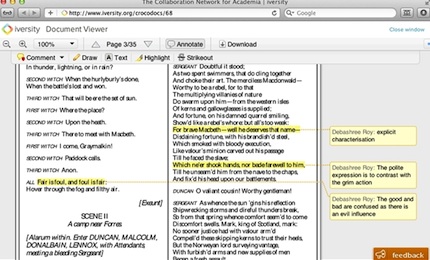
Currently, iversity is available in English and German.
One beta tester, Thomas Goldstrasz, a lecturer at the University of Applied Science Düsseldorf, explained the philosophy of the Web-based system. "The idea is to give students more freedom and to support them in the preparation of their coursework by providing them with real-time feedback, comments, and suggestions online. This approach has the benefit of motivating independent research; it encourages the continuation of high-quality discussions outside the classroom and thus teaches what is most important in today's complex new media environment: the competence to acquire new competencies."
While the software is free to individual users, iversity also provides customized services commissioned by the institutions that use it. In Germany the company is also offering a low-cost service that allows students to order printed copies of faculty-assigned reading without having to visit the local copy shop in person.
The work was initially funded by a scholarship from the German Federal Ministry of Science and Technology. Then the company received an additional infusion of a million Euros from a Brandenburg-based regional development organization that used both EU and local funds as well as a German venture capital firm.
About the Author
Dian Schaffhauser is a former senior contributing editor for 1105 Media's education publications THE Journal, Campus Technology and Spaces4Learning.