Rochester Institute of Technology
|
Project: The Research Network
Project lead: Chandra McKenzie, assistant provost for academic affairs
Tech vendors/partners:
|
How do you discover researchers to collaborate with, even on your own campus? At large universities, many people are often working on similar problems in isolation, simply because they are not aware of who else might be doing related work in their own or other departments.
Researchers at the Rochester Institute of Technology (NY) think they have found an answer to that question by expanding the reach of a homegrown social bookmarking tool called RIT BookBag. Built with Drupal, the open source project allows users to share links with one another. Faculty members use BookBag to research course topics, share their findings with their classes, discuss resources with students, and involve students in discovering course content.
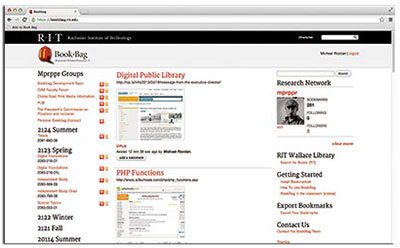
RIT BookBag allows users to share resources, find other individuals studying similar topics, and form groups to collaborate around specific subjects. |
Now that it has been available for a year and a half and is gaining enthusiasts among the faculty, BookBag's developers have launched phase two: the Research Network. The new tool allows people to find other individuals on campus studying similar topics and form their own groups to collaborate around specific subjects.
Likened to Pinterest for research, the Research Network automatically catalogs each web resource saved in RIT BookBag via natural language processing, and maps it to other web resources bookmarked in the system, explains Michael Riordan, one of the developers and a professor in RIT's School of Media Sciences. By mapping who bookmarked a particular resource, the Research Network recommends similar resources and enables researchers to identify potential collaborators.
"This phase two is a natural evolution of phase one use in the classroom," says project lead Chandra McKenzie, assistant provost for academic affairs. "We want to continue to figure out how this tool can help campus communities share resources. We don't have specific goals in terms of numbers of users. We are now more focused on getting it into people's hands and seeing how the use cases evolve."
The original target group for BookBag was faculty working with undergraduate students in their classrooms. But McKenzie believes faculty and graduate student researchers will find the idea of sharing resources intriguing.
Riordan notes that faculty members and students have gotten used to the idea of browsing content they have bookmarked in particular classes. "Now the system will start suggesting other people and content based on what you are looking at. You can just click a button and follow other people just like you can on Twitter," he explains. "Once you follow people, the Research Network will suggest other people with similar interests just as Twitter does. The system is context aware."
To address privacy concerns, the developers created an opt-out procedure. When users add content to a class BookBag, everyone in their class automatically sees it. "But we have also created a way to use BookBag that is private," Riordan explains. "You can have your own personal BookBag, with the option of sharing it with others or not."
The software-development process was quite involved, says web developer Pat Reed. RIT BookBag is fully integrated with RIT's existing systems, allowing it to leverage single sign-on and link deeply into library-managed resources. "There are several IT systems tied in, especially library catalogs as well as RIT databases," he adds. "It is tied into the student information system so that, when students log in, it creates a personal BookBag for them. It travels with them throughout their RIT careers, and then when they graduate there is a tool for them to export that data if they wish."
In May, the development team exhibited the Research Network at the Imagine RIT Innovation and Creativity Festival, which brings 25,000 people to campus. At the festival, Riordan met a math professor interested in data visualization and social networks, and they both realized that they are doing research in overlapping areas. "Using BookBag's research network would have helped us make the connection before now," Riordan says.
That realization is echoed by one senior about to graduate, who told Riordan: "If I had had access to a research network during my time here, I would have used it to create connections with people who had skills or talents that I lacked, or hoped to acquire." Another student said that the campus is very large and very much siloed by both location and discipline. "I could see this [Research Network] tool helping organic relationships develop that are both academic and career-focused."