Union County College
|
Project: Superstorm Sandy disaster relief plan
Project lead: Margaret McMenamin, president
Tech vendors/partners:
|
As Union County College (NJ) President Margaret McMenamin surveyed her storm-ravaged neighborhood the morning after Superstorm Sandy ripped across the Eastern Seaboard, she knew she had a monumental task ahead of her.
"I knew we had to reopen our campus, right away," she recounts. "Most of New Jersey had no electrical power, so people didn't know what was going on. We had to find a way to reopen our schools, start communicating with people, and get students back to classes."
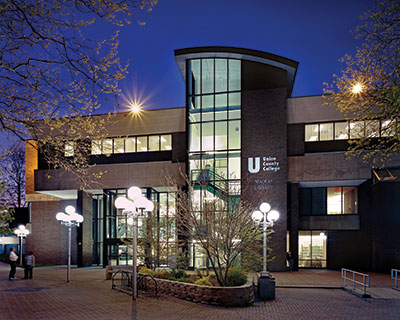
Union County College opened just three days after Superstorm Sandy devastated the Eastern seaboard, thanks to the relentless--and innovative--recovery efforts of its president, faculty, and staff. |
While UCC did have an existing disaster strategy, the devastation caused by Sandy was beyond what anybody expected. The institution's inner city facility, Elizabeth, had power but the main campus in Cranford had to close. It had no power and damage to the area was estimated at more than $6 million, according to news outlets. Worse, early reports predicted it could take up to two weeks to restore services. If this happened, how would the school recover and continue the semester?
McMenamin quickly assembled her team to hammer out a new plan, scraping together every possible tool at their disposal. Their chief goals were to reestablish communication with the community, protect billable credit hours and ensure students could finish the semester, and preserve critical IT systems and business functions. The Elizabeth campus became the command center through which they'd carry out the plan and serve the battered community.
Beth Ritter-Guth, director of instructional design for UCC, recalls McMenamin contacting her through an unconventional outlet: Twitter. It was just after midnight on Oct. 30, Ritter-Guth says, when McMenamin tweeted to ask her if the college's Angel learning management system was functional: "She said we'd need a solution in place [for restarting classes] if campuses had no power after the storm."
Ritter-Guth immediately contacted her Blackboard support manager, Brett Nabb, for help. They needed to create a "shell," a system by which students could access classes online through Angel, which was hosted off-site in Indianapolis. (While UCC had a small number of online students, most typically attended class at one of the school's three campuses.) All classes, except labs, would now be delivered through Angel. If students couldn't get to Elizabeth for classes, they could still attend online from any web-enabled device.
The pair worked through the night, and by morning it was ready. McMenamin again turned to Twitter to notify faculty that Angel was up and instructed them to send course content to Ritter-Guth for posting. By the weekend, all classes were in Angel.
Users soon hit a snag, however. Students trying to access the LMS from their mobile devices couldn't get past the authentication wall. Nabb quickly created a "backdoor" that allowed students to circumvent the single sign-on step and get into the shell.
Angel became UCC's primary communication system during the recovery period. Since the system was hosted remotely, it was more reliable than other communication channels. "Only Angel and the website stayed up without fail," says McMenamin. In addition, the school used every possible system--Angel, website, SMS, e-mail, Twitter, and Facebook--to send updates. "At one point the only way I could communicate was via Words With Friends chat!" recounts McMenamin.
Preserving UCC's IT infrastructure was another challenge. All IT systems were housed at the storm-battered Cranford campus, which was now running on power supplied by diesel-fueled generators. If the generators failed, the school would lose its website and e-mail systems. Data loss would be catastrophic.
Diesel became the priority, says McMenamin, and facilities and public safety staff began scrambling to find fuel. Complicating the matter was the fact that gas stations throughout New Jersey were running dry. Thankfully, the school got its hands on a 55-gallon drum, which was filled with diesel from another campus's reserves and transferred to Cranford.
UCC's persistence paid off. By the end of the hurricane week, 85 percent of the faculty were working in Angel. One week later, 99 percent of the full-time faculty and 92 percent of the part-time faculty were in the system. Best of all, completion rates for the fall were 75.4 percent, just 0.2 percent lower than fall 2011.
McMenamin credits her team for the successful recovery. "It was a collegewide effort," she says. "My staff and faculty all stepped up to make this happen. It was my proudest moment at Union County College."