The University of Virginia Opts For EBSCO's Library Search Tool
The University of Virginia has changed the retrieval system it
uses in its libraries,
moving from ExLibris' Primo Central to EBSCO
Discovery Service's EDS
API.
One
of
the top public research institutions in the United States, the
university in
Charlottesville, VA, has more than 5 million print volumes, nearly
463,000
e-books and dozens of electronic databases in its multiple library
collections.
Unhappy
with
the online search tool they were using, university librarians began
their
search for a better tool.
"We
have
so many online resources, so we were trying to figure out how to make
sure
that the discovery service had the best chance of being used," said
Esther
Onega, head of the Brown Science and Engineering Library and a member of
the
committee that conducted the search for a new tool.
The
main
problem the committee wanted to solve was how to make sure the search
tool
provided researchers, students and faculty with the most relevant
information.
"A
lot
of things, such as book reviews, were coming up first — not scholarly
articles," she said.
| |
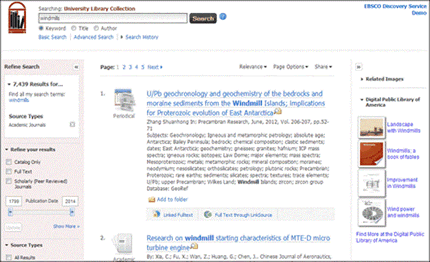
The University of Virginia’s new library search will prioritize scholarly articles over other kinds of content, like book reviews. |
|
As
an
example, she pointed to a search for articles about "fuel cells," noting
that
the article at the top of the list had been written in 1964.
"A
lot
has been done on fuel cells since 1964," Onega said. "I really couldn't
stand behind those article results."
After
a
search that lasted nearly a year and a six-month trial period, the
university
chose ESCO's EDS API, which streamlined access to library resources
through a
single search box.
First,
Onega
said, the EDS API prioritizes recent scholarly articles, making
researchers' searches for relevant material much easier.
She
also
said the university was happy with its application programming interface
and the fact that it is more intuitive than other discovery services it
looked
at.
"One
of
the other discovery services broke down subject phrases into words and
listed them separately in the facets, which made for a confusing
display,"
Onega said. "The faceting was especially helpful in EDS."
Finally,
she
said the committee felt EBSCO's customer support was superior to that of
other vendors they spoke to.
The
libraries
launched EDS in June, following the close of the spring semester, so
it will be fully up and running when students and faculty begin to
return to
campus for the fall semester in a few weeks.
About the Author
Michael Hart is a Los Angeles-based freelance writer and the former executive editor of THE Journal.