$169 Wireless Whiteboard System Has Just 3 Components
IPEVO today launched a low-cost wireless interactive whiteboard system comprised of a pen, wireless receiver and sensor cam.
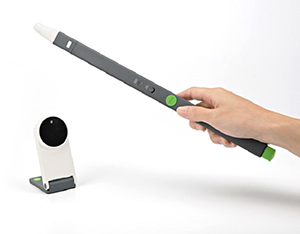
The IW2 system comes with three components and a projection screen is available at an additional cost.
Classroom technology company IPEVO has introduced a new wireless interactive whiteboard system priced at just $169.
The IW2 system is equipped with three portable devices, and can use just about any flat surface as a display space. First, an interactive pen allows users to draw and control software apps remotely, much like a wireless mouse (including "drag-and-drop" functionality and right and left button clicks). Second, a wireless receiver can be plugged into any USB port, allowing the third element, the sensor cam, to communicate with any computer. The sensor cam receives infrared signals from the interactive pen and translates them into cursor movements and mouse button presses. According to an IPEVO release, the whole system can be set up, calibrated and put into use in less than five minutes.
"Teachers need affordable options to create technology-rich classrooms," said IPEVO CEO Royce Hong. "The IW2 is not only budget-friendly, it's intuitive and an easy-to-use technology that increases student engagement without the need for training."
An optional projection screen with a magnetic backing for easy installation is also available for $109.
For more information, visit the IPEVO site.
About the Author
Michael Hart is a Los Angeles-based freelance writer and the former executive editor of THE Journal.