Penn State Teams Turn to AI for Solving Student Problems
- By Dian Schaffhauser
- 05/10/18
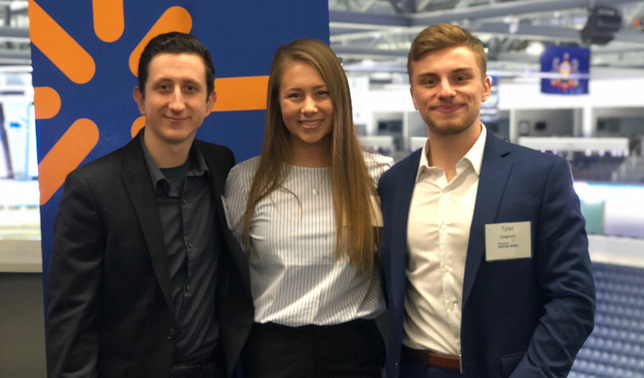
Penn State students Shane Hepner, Isabelle Biase and Tyler Spagnolo are part of Aspire, a team competing in the university's EdTech Network Nittany AI Challenge.
A student team at Penn State University has created Aspire, an application to help students map out their college careers by offering AI-generated recommendations on experiences and skills needed for their dream jobs after graduation. Another team is using machine learning to scale up competency-based learning by integrating human and algorithmic grading for instant student feedback.
These are two of the five prototypes students, faculty and staff at the university are working on as part of this year's Nittany AI Challenge. The artificial intelligence challenge is overseen by the Penn State's EdTech Network, which builds relationships between the campus and industry. (The name "Nittany" is tied to the institution's mascot, the Nittany lion, whose origins are "a bit obscure," according to the university.)
This year, as part of the challenge, the institution is working with IBM, Amazon Web Services, Google Cloud, Microsoft and Blackboard, among other partners, all of which have offered workshops, training and mentoring to help the student teams understand AI and how to use the various platforms. Each student team also has a faculty leader to help guide its efforts.
An original round involving 71 teams was whittled down to 10 teams, each awarded $2,500 to develop prototypes using an AI tool. Five teams were chosen from those 10 to receive $5,000 each for the next phase of development for their product ideas. Besides Aspire and the competency-based learning tool, the other finalists include:
- LionPlanner, which provides guidance to students on opportunities related to their career pursuits, such as clubs, courses, activities and electives;
- Pathfinder, an application that uses machine learning to recommend course pathways, based on past course enrollment and performance of other students; and
- ProFound, a system that retrieves public information about a given faculty member, such as research interests, categorizes it and places it into a portal for students to access.
"As a freshman at Penn State, it is overwhelming to navigate all of the incredible opportunities offered here. I want to figure out how to most effectively use my time for success in the future," said Isabelle Biase, a freshman majoring in computer science and a member of the Aspire team, in a press release. "The pathways alumni have taken, from joining clubs to internships, have helped them with their careers and are valuable insights to use as a way to define paths for others."
The Aspire team is using IBM Watson Knowledge Studio to navigate those paths and bring them together in one application.
"We've started collaborating with multiple offices here at Penn State, such as Career Services and Development, to connect us with a large number of alumni," added Tyler Spagnolo, a sophomore majoring in CS and another member of the Aspire team. "Moving forward, there will be a direct correlation between the success of our tool and how well we can collect the desired information from Penn State alumni."
In the next part of the competition, taking place next fall, a panel of judges will award additional funding to those projects that have shown the most progress.
Daren Coudriet, director of the Penn State EdTech Network, said participants are gaining hands-on experience solving real problems with AI, uniquely positioning them as innovators. "Experience in working with AI is valued in today's marketplace because of the widespread application of this technology," he noted. "Participation in this EdTech Network challenge will likely have a direct impact on a student's marketability."
About the Author
Dian Schaffhauser is a former senior contributing editor for 1105 Media's education publications THE Journal, Campus Technology and Spaces4Learning.