Survey: Instructional Designers Drive Better Student Outcomes
- By Dian Schaffhauser
- 03/26/19
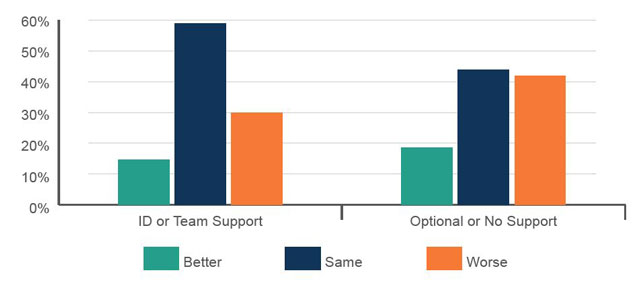
Online student performance compared to face-to-face students, with and without instructional design support (Source: 2019 CHLOE 3 Report)
When faculty are compelled to work with instructional designers on development of their online courses, students have better outcomes, according to a recent survey from Quality Matters and Eduventures Research, the research division of ACT/NRCCUA. In schools where instructional design for online course development was absent or optional, 58 percent of "chief online officers" (COOs) believed that students taking those courses would perform at least as well if not better than those in face-to-face classes; that jumped to 70 percent where instructional design was mandated.
Community colleges were least likely to require the involvement of instructional design specialists, with a full two-thirds (67 percent) reporting absent or optional design support. At the other extreme were "institution-wide programs," where just 28 percent had no such requirements.
Those findings surfaced in the third annual "Changing Landscape of Online Education " (CHLOE 3) report, which surveyed 280 COOs (up from 182 last year) at U.S. colleges and universities about policies, practices and plans around online education. Researchers defined the role of "chief online officer" as having lead or shared responsibility for online faculty training, online instructional design and course development, coordination with academic units, online policy development, quality assurance and overall strategic planning.
Across all types of institutions, the median number of instructional designers employed was four. Community colleges reported a median of one person in this role; regional four-year private schools had a median of four; and regional four-year publics had a median of five.
While "there seems to be growing acceptance that instructional design expertise can help to make online courses more effective," achieving broader adoption of instructional design expertise "faces some persistent headwinds," specifically cost and "entrenched faculty attitudes," the report noted.
When asked why their colleges and universities made instructional design support voluntary, limited or absent altogether, one of the most common COO responses was insufficient resources, cited by 58 percent. The use of instructional designers "obviously [has] financial implications," the report noted. But more surprisingly, an equally large share of COOs also specified faculty autonomy or academic freedom as the barrier. This dominance of faculty control over the decision has many origins, respondents added. As one observed, "Poorly designed courses are their choice." In other places, it was pointed to as a holdover from faculty developing their face-to-face courses without instructional design input or going into the business of creating their online courses without such support and then not taking advantage of it when it was made available. In other places, the "institution-wide perspective" was that instructional design was nothing more than learning management system "button-pushing that could be done by student workers." Or there was simply a lack of administrative support for "a uniform and enforced model across the institution."
The full report, which explores trends in the management of online education as well as the tools and techniques employed in online programs, is available on the Quality Matters site (registration required). A webinar on the findings will take place on April 11, 2019 at 1 p.m. Eastern time; the event is open to members and non-members.
About the Author
Dian Schaffhauser is a former senior contributing editor for 1105 Media's education publications THE Journal, Campus Technology and Spaces4Learning.