U Michigan Tool Helps Students Learn How to Work in Teams
- By Dian Schaffhauser
- 01/09/20
Three engineering faculty members at the University of Michigan — all female — who have co-taught an Introduction to Engineering course have come up with a new tool at the institution to help students learn how to work in teams. The faculty team pursued the new solution as a replacement for doing weekly check-ins with students. That original approach, described in a video about the project, was "awesome and terrible," according to Robin Fowler, lecturer in technical communication and research scientist in Engineering Education Research. It used a mix of peer assessment, reading and reflections to develop an understanding of the effectiveness of the teams in which students worked. However, the workload for the faculty was staggering, she noted. "It meant I was going home and reading 60 reflections on some topic [every week]."
It was "great," added Laura Alford, a lecturer and research investigator in naval architecture and marine engineering, "but it was not sustainable."
Together with the third instructor, Stephanie Sheffield, a lecturer in technical communication, the group reached out to the university's Center for Academic Innovation for help in combining their model with the technological approach of ECoach, an existing program developed on campus for helping students navigate large intro courses where one-to-one interaction with instructors is rare.
The result, called Tandem, supports group work in courses. It delivers "tailored lessons" about how to work in teams and feedback about how the teams are doing. The utility includes customizable surveys about team members' personality traits and the team orientation. Data generated from those surveys is compiled to tailor feedback to team members and keeps instructors informed about "team health," so they can intervene and offer real-time correction when student group activities are heading off the rails.
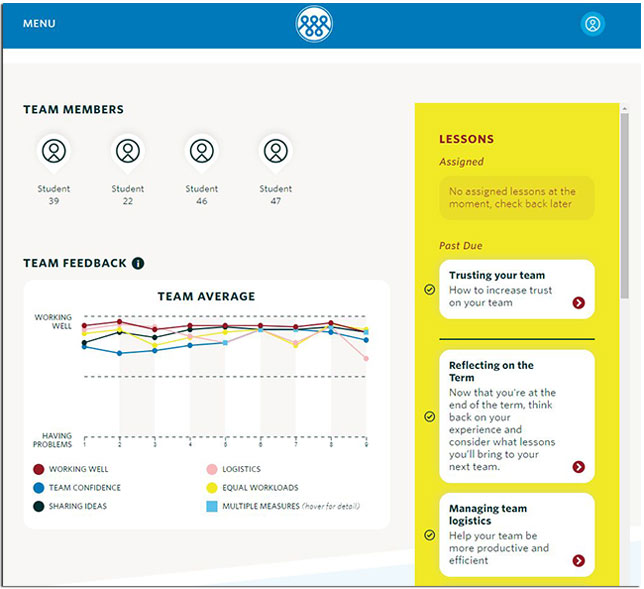
Tandem's student view
"Our goal is that Tandem will determine when a team is not meshing in the ways that members need to and it will generate that support early on," said Sheffield in an article about the project. "If it's a minor issue, it will suggest readings or issues, and messaging to nudge them in the direction they need to go. Or nudge them to sit down with faculty or just raise the awareness that something's going on here."
According to Engineering 100 student Emily Grim, working on a team in a course is harder than doing the work herself. She found that Tandem provided a way for team members to voice their concerns and "get on the same page."
"I personally loved the Tandem feature where group members can rate each other's contributions," she said. "My group had a member who severely lagged in pulling his own weight in projects, and we could tell him that in a way he couldn't argue it or get upset with us."
She added that the tool also "helped me by showing me the things I did well and the things I could improve on, which were all things I didn't initially see as areas for improvement."
That kind of personal insight is invaluable, said Molly Maher, a behavioral scientist from Academic Innovation and member of the team that developed Tandem. "The core message to get across is that there will be problems when you work on teams, and that you play a part in them and have options for how to respond. And knowing more about yourself and understanding team members is the way to do that," she explained.
Scott Goutman, an aerospace engineering student, said he found the articles and resources provided with the tool to be most helpful. Another takeaway for him: "The idea that you envision when you begin a group project is going to be very different from the result. That is a normal part of the design and engineering process."
The tool was alpha tested in winter 2019 and will be piloted this fall with sections of Engineering 100, as well as two other courses: Business Administration 200 and Architecture 672. Testing will continue in Engineering 100 and in the School of Information 339 in winter 2020.
The university has set up a website to demonstrate the software.
About the Author
Dian Schaffhauser is a former senior contributing editor for 1105 Media's education publications THE Journal, Campus Technology and Spaces4Learning.