Amgen and Harvard Launch Free Online Science Ed Platform
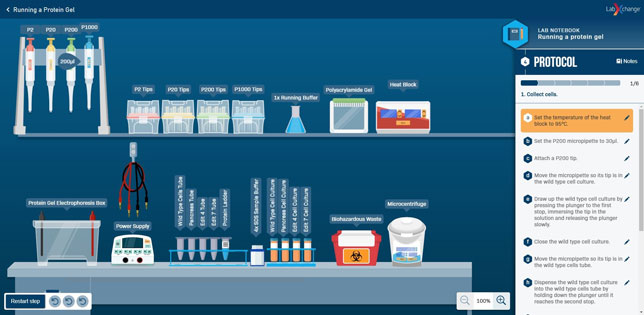
LabXchange
A new online science education platform offers free access to personalized learning content, virtual lab experiences and networking with the global scientific community. Created by the Amgen Foundation and Harvard University's Faculty of Arts and Sciences, LabXchange is "purpose-built to drive more inclusion in the scientific process and spark collaboration to build creative, team-based approaches to real-world problems," according to a news announcement.
"Too many high school and college students lack the opportunity to directly explore the scientific process — where you build a hypothesis, understand a method and determine how to apply it to an appropriate experimental problem," said Robert Lue, principal investigator of LabXchange and professor of the Practice of Molecular and Cellular Biology at Harvard, in a statement. "For many students, science can feel like a collection of facts to memorize — which is contrary to what the scientific process is — it's a journey that requires bold thinking and deep imagination. With LabXchange, more students can come together and experience the joy of discovery."
Features of the platform include:
- Multimedia learning materials, including videos, interactive simulations and assessments;
- Virtual lab experiments illustrating molecular and cellular biology techniques;
- The ability for instructors to mix and match materials according to curricular needs; and
- Networking tools that enable collaboration across a classroom, school or district.
For more information, visit the LabXchange site.
About the Author
Rhea Kelly is editor in chief for Campus Technology, THE Journal, and Spaces4Learning. She can be reached at [email protected].