Updated Johns Hopkins Coronavirus Map Adds Local Data
coronavirus map

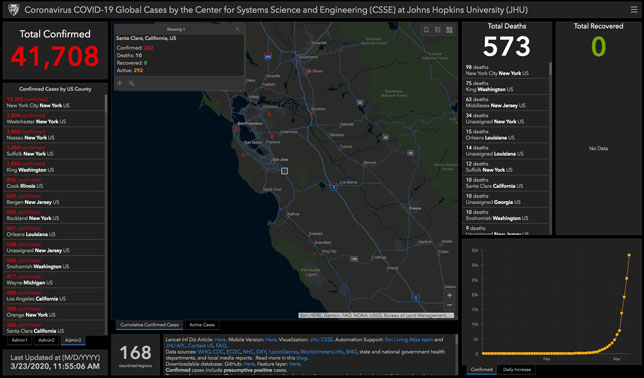
Screen capture of coronavirus data from Santa Clara County, CA, as of March 23, 2020

Johns Hopkins University has upgraded its COVID-19 tracking map to include local data from every city and county in the United States. When users zoom in on the U.S. map, they can now click on each county to display the numbers of confirmed cases, active cases, deaths and recoveries for that jurisdiction.

State- and local-level information can also be viewed through the vertical country column on the left-hand side of the map; when users click on "U.S." in that column, they can then navigate to state and local data via the "Admin" tabs at the bottom of the column.

The update will also "allow for adding features later that will deliver broader insights about the pandemic," according to the university, and all the map data continues to be freely available in a GitHub repository.

The map and additional resources are available on Johns Hopkins' online portal.

About the Author

Rhea Kelly is editor in chief for Campus Technology, THE Journal, and Spaces4Learning. She can be reached at [email protected].

Featured

  • glowing crystal ball with network connections

    Call for Opinions: 2026 Predictions for Higher Ed IT

    How will the technology landscape in higher education change in the coming year? We're inviting our readership to weigh in with their predictions, wishes, or worries for 2026.

  • digital book with circuit patterns

    Turnitin and ACUE Partner on AI Training for Educators

    Turnitin is teaming up with the Association of College and University Educators to create a series of courses on AI and academic integrity designed to help faculty navigate the responsible use of AI in learning and assessment.

  • Hand holding a stylus over a tablet with futuristic risk management icons

    Why Universities Are Ransomware's Easy Target: Lessons from the 23% Surge

    Academic environments face heightened risk because their collaboration-driven environments are inherently open, making them more susceptible to attack, while the high-value research data they hold makes them an especially attractive target. The question is not if this data will be targeted, but whether universities can defend it swiftly enough against increasingly AI-powered threats.

  • Red alert symbols and email icons floating in a dark digital space

    Google Cloud Report: Cyber Attackers Are Fully Embracing AI

    According to Google Cloud's 2026 Cybersecurity Forecast, AI will become standard for both attackers and defenders, with threats expanding to virtualization systems, blockchain networks, and nation-state operations.