Stony Brook Team Builds Spare-Parts Ventilator in 10 Days
- By Dian Schaffhauser
- 04/21/20
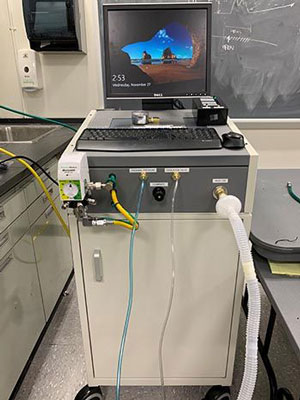
The CoreVent 2020, assembled into a patient-ready prototype and usable in a critical care setting. Photo courtesy of Stony Brook University.
A cross-disciplinary team at Stony Brook University in New York has prototyped and tested a ventilator that could be used as an alternative to standard ventilators should the supply run out. The project was done in 10 days.
The work was led by Jon Longtin, an associate dean in the College of Engineering and Applied Sciences and a professor of mechanical engineering. The team also included John Brittelli, a clinical professor in the Respiratory Care Program in the School of Health Technology and Management, and Brian Margolis, a medical doctor and pulmonary disease specialist at St. Catherine of Siena Medical Center. Other faculty, healthcare practitioners and clinicians were also involved.
According to the university, the ventilator was designed with simplicity in mind and "ease of fabrication" for a crisis situation. The team worked "day and night" to design, prototype, test and refine the "CoreVent 2020," a "computer-controlled, pressure-cycled, time-limited ventilator" that offers an assisted-breathing mode and the functionality for applying positive end-expiratory pressure (that part of breathing that exists at the end of expiration). It uses no proprietary components, includes low- and high-pressure alarm functions and provides visual system status indicators and a menu-based computer interface to control the ventilator.
"During this extraordinary time in medicine, it is vital that all corners of a research-oriented university be engaged to solve the myriad of problems facing healthcare professionals caring for our patients," said Kenneth Kaushansky, dean of the School of Medicine, in a statement. The development of the CoreVent 2020 in such a short timeline, he added, quoting New York Governor Andrew Cuomo, "illustrates that 'what we do here, what we do now, will define us.'"
Currently, the university is in discussions with New York-based Biodex Medical Systems, a medical device provider, to manufacture initial units of the new ventilator as the COVID-19 crisis in the state dictates. The campus currently hosts a coronavirus triage service, which is staffed with emergency medicine physicians and nurses, managed through the Stony Brook University Hospital.
About the Author
Dian Schaffhauser is a former senior contributing editor for 1105 Media's education publications THE Journal, Campus Technology and Spaces4Learning.