UCLA Esports Players Find Ways to Keep the Gaming Going Remotely
- By Dian Schaffhauser
- 06/01/20
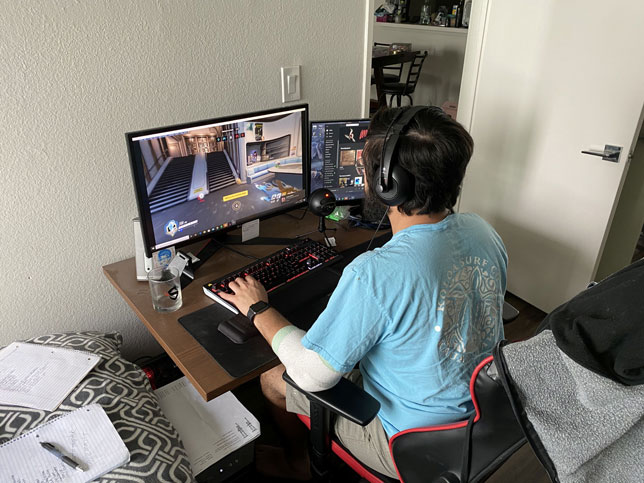
UCLA esports varsity player Naveen Sheik plays on the Overwatch team from his room during the COVID-19 pandemic. Photo courtesy of Naveen Sheik
While the University of California Los Angeles had to close its new esports training facility (along with every other campus facility) in response to the COVID-19 pandemic, team members are playing on, from bedrooms and flat-panel displays around the country, according to a recent university article.
UCLA has both varsity and junior varsity teams for League of Legends, Overwatch and Hearthstone and one team each for Rocket League, Dota 2 and Super Smash Bros. Ultimate.
Student Director of UCLA Esports and graduating senior Ashley Denktas has issued each team manager a specific game night within the school's Discord space, where players can communicate with each other while streaming their gameplay. That doesn't mean those game nights have taken the place of regular practices and games for everybody, however. As Denktas noted, coordinating time zone differences among students and the lag time introduced by varying calibers of internet access makes that notion impractical. "It's not debilitating," she said. "But we have some players with iffy connections. Without the right equipment, they feel like they can't play at their best level."
In spite of those obstacles, senior Naveen Sheik, a varsity Overwatch player and marketing director for the UCLA club sport, pushes his team to participate in two-hour practices and scrimmages regularly, often two or three times a week. To keep the teams engaged and give them practice building an audience, Sheik has set players up to stream their gameplay live on the UCLA Esports Twitch channel.
For Sean Moore, a first-year student on the Overwatch junior varsity team, the quarantine has opened up more practice time, since there are so few other activities players can participate in currently. However, Moore emphasized, teams have to be careful not to scrimmage on their main UCLA accounts against just anyone. Apparently, players can lose skill points if they're not playing against other teams with similar ratings. "Losing skill points isn't like getting injured and benched," he said. "It's just that we've earned those ratings, and we don't want to lose them on a practice session testing out a new strategy."
Still, said Denktas, "hanging out online isn't the same." As she pointed out, with the new on-campus training center, which opened in February, players could cheer each other on or turn to a teammate and congratulate them on their play, and people could go out together afterwards. "Even though everyone's still active, we're still saying, 'Man, I wish we could all go out for Korean barbecue again.'"
About the Author
Dian Schaffhauser is a former senior contributing editor for 1105 Media's education publications THE Journal, Campus Technology and Spaces4Learning.