Internet2 Chooses Cisco for Next-gen Infrastructure
- By Dian Schaffhauser
- 10/08/20
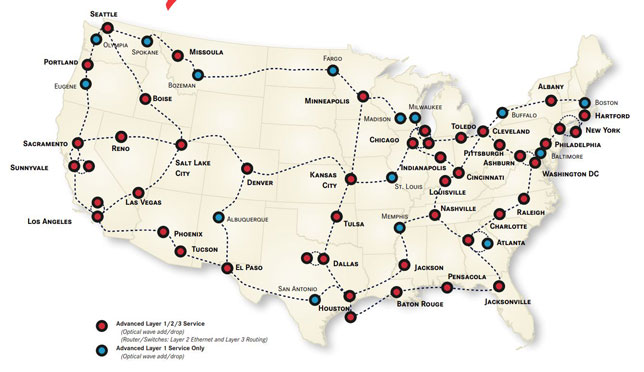
The Internet2 network infrastructure topology, as of October 2020. Source: Internet2.
The nonprofit high-speed internet community that is Internet2 has struck an agreement with Cisco to build out its research and education infrastructure using technology from the company. The alliance between the two organizations is part of a "next-generation infrastructure" initiative at Internet2, begun to provide support specifically for data-intensive research projects.
Cisco was chosen through a proposal process reviewed by networking experts from the Internet2 community and the organization. It isn't the only vendor involved in the infrastructure work. Earlier this year, Internet2 announced its first transitions to a new optical network using Ciena gear.
The new equipment from Cisco — the 8200 series routing platform — is expected to provide 400 gigabit/second capacity; dual contiguous routes will accommodate 800G bandwidth. A move to segment routing will allow researcher applications to eventually claim up to an entire 400G link for a particular application while other network uses are dynamically moved to other paths.
Cisco 8201 and 8202 routers will be deployed in 48 locations across the country, with between one and four devices per location. A typical node connecting national backbone resources with regional networks has between 24 and 96 400G network access ports.
A drop in energy usage of a minimum of 61 percent is also expected, reducing the carbon footprint on the national backbone by an estimated 334 metric tons per route.
The agreement also includes collaborative opportunities for the two entities to support research activities and multi-domain service orchestration with campus and regional partners. Cisco is also offering incentive programs for regional networks and campuses to adopt similar technologies for their own network upgrades.
"Research and education networks have never been more critical than they are today, and the selection of Cisco is a very exciting and critical milestone for the R&E community," said Howard Pfeffer, Internet2 president and CEO, in a press release. "Cisco is supporting the delivery of a software-driven infrastructure that enables rapid deployment of new services and tight integration with applications and scientific workflows on the campus and in the cloud, both of which are essential to our nation's future. Cisco has also made substantial commitments not only to Internet2, but to the broader R&E community, by pledging ecosystem-wide support that helps us bridge campus, regional, national and international needs."
About the Author
Dian Schaffhauser is a former senior contributing editor for 1105 Media's education publications THE Journal, Campus Technology and Spaces4Learning.