Grammarly Adds New Features to Make Citations Easier

Grammarly is rolling out two features to its AI-powered writing assistance software, aiming to help students writing research papers use citations correctly: citation style formatting and auto citations. Both features conform to the latest style guides: APA 7, Chicago 17, and MLA 9, the company said in its announcement.

With citation style formatting, Grammarly instantly proofreads in-line and bibliography citations for mistakes, including incorrect commas, parentheses, or ampersands. This Premium-user feature is available in Grammarly Editor, which also checks papers for accidental plagiarism, Grammarly said.

The auto-citation feature scans tens of millions of articles found in the 10 largest research databases and automatically creates the proper citations. This tool is available to both free and Premium users, the company said, and it can be used on the following websites: Wikipedia, Frontiers, Plos One, Science Direct, Sage Journals, PubMed, Elsevier, DOAJ, arxiv, and Springer.
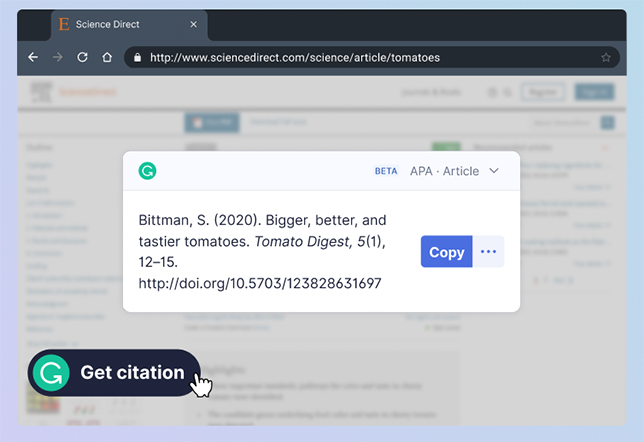
Grammarly has rolled out new features to make citations easier for students writing research papers

Grammarly's base subscription is free to use. Secondary schools and higher education institutions can also purchase a Grammarly for Education premium subscription that provides licenses for all institutional users.

For more information, visit Grammarly.com.

About the Author

Kate Lucariello is a former newspaper editor, EAST Lab high school teacher and college English teacher.

Featured

  • InCommon Academy in action with an Advance CAMP unconference activity at the Internet2 Technology Exchange

    Community-Driven IAM Learning with Internet2's InCommon Academy

    Internet2's InCommon Academy Director Jean Chorazyczewski examines how the academy's community-driven identity and access management learning opportunities support CIOs, IT leaders, and their IAM teams in R&E.

  • businessman juggling cubes

    Anthology Restructures, Focuses on Teaching and Learning Business

    Anthology has announced a strategic restructuring, divesting its Enterprise Operations, Lifecycle Engagement, and Student Success businesses and filing for Chapter 11 bankruptcy in an effort to right-size its finances and focus on its core teaching and learning products.

  • Jasper Halekas, instrument lead for the Analyzer for Cusp Electrons (ACE), checks final calibration. ACE was designed and built at the University of Iowa for the TRACERS mission.

    TRACERS: The University of Iowa Leads NASA-Funded Space Weather Research with Twin Satellites

    Working in tandem, the recently launched TRACERS satellites enable new measurement strategies that will produce significant data for the study of space weather. And as lead institution for the mission, the University of Iowa upholds its long-held value of bringing research collaborations together with academics.

  • Hand holding a stylus over a tablet with futuristic risk management icons

    Why Universities Are Ransomware's Easy Target: Lessons from the 23% Surge

    Academic environments face heightened risk because their collaboration-driven environments are inherently open, making them more susceptible to attack, while the high-value research data they hold makes them an especially attractive target. The question is not if this data will be targeted, but whether universities can defend it swiftly enough against increasingly AI-powered threats.