Trust and Transparency Are Key Factors When Using AI in Academia
Much can be learned from embracing artificial intelligence in the teaching and learning process. Here, two professors share their experiences using ChatGPT freely in the classroom.
- By Dr. Andrew Lang
- 06/30/23
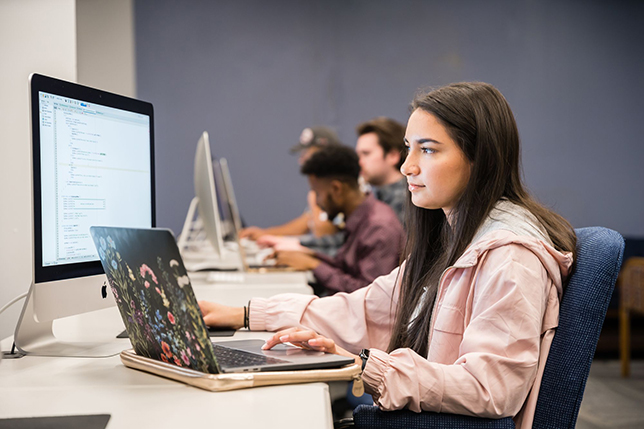
Photo courtesy of Oral Roberts University
Two professors in the Computing & Mathematics Department at Oral Roberts University — Professor Sasha Turtova, Instructor of Mathematical Linguistics, and Dr. Jan Wörner, Assistant Professor of Computer Science — have integrated the use of AI to enhance the teaching and learning process in introductory composition and computing classes, respectively. In a recent interview, they sat down to discuss their experiences thus far.
"My area of research in corpus linguistics and my interest in teaching writing were the driving forces behind my initial fascination with AI," said Turtova. "I was particularly intrigued to witness how students would respond to AI tools and the potential impact on their writing skills. In my COMP 101 – Composition I class, students were given the opportunity to utilize ChatGPT during class activities and outside of class while working on assignments. For instance, one group project involved creating a fictional story, where each group had to incorporate randomly selected challenge words. Students were free to use ChatGPT as they saw fit to develop their story ideas." By allowing students to freely utilize ChatGPT during both in-class activities and independent work, Turtova not only taps into the potential of AI to enhance students' writing skills but also encourages creativity and critical thinking.
Turtova continued: "Outside of class, students were encouraged to use ChatGPT for brainstorming, generating text, and revising their work without any limitations or penalties. Interestingly, only two of the 15 students relied solely on ChatGPT for text generation, while the rest used it as a writing tool with their own input. Many students enjoyed interacting with the AI and found value in developing skills related to AI usage and their writing abilities. Additionally, the end-of-semester surveys revealed that students believed the course provided various learning opportunities. From my observations, it became evident that students who actively utilized ChatGPT as a writing tool, engaging with the generated text, achieved better and more consistent results than those who solely relied on it for text generation." Turtova's observations align with the notion that active engagement with ChatGPT as a writing tool yields improved and consistent outcomes compared to passive reliance on it for text generation alone.
When asked about challenges and how she overcame them, Turtova responded: "One of my main challenges was the lack of research in writing and AI, making it uncharted territory. To address this challenge, I decided to employ ChatGPT without imposing any restrictions, allowing me to gauge the responses and outcomes of university-level writing. It was a deliberate choice to move forward without preconceived notions about the types of responses and results we would obtain from the students, which added an element of exploration and discovery to the experiment. As more faculty incorporate AI tools into their classrooms, it becomes crucial to establish trust and transparency. With increased usage, more research and data will become available. It is essential for both faculty and students to understand that AI tools may present biased or erroneous information, necessitating the involvement of human experts with the experience to evaluate the freely generated text produced by AI. By acknowledging the limitations of AI and promoting critical thinking, we can navigate the intersection of AI and education more effectively, harnessing its benefits while mitigating its shortcomings."
Wörner added to the conversation by shedding light on the profound impact AI is having on his teaching and learning processes: "I incorporated ChatGPT into my Introduction to Computing class. I had the students create a program using ChatGPT and then analyze whether it fulfilled the requirements. So, we created a tracing table for the algorithm, and we developed a test plan to prove that the program was working. It was interesting for the students to discover that some programs did not perform as expected, teaching them the importance of providing detailed requirements to create the correct program using ChatGPT."
When asked about the changes in student behavior or attitudes towards learning resulting from incorporating AI into teaching, Wörner responded, "The students greatly appreciated learning that an AI tool may not always be right or correct. They also valued understanding how to verify and review results using other tools. After analyzing a Python program created by ChatGPT, three students approached my desk and said, 'Professor, today we learned how to program Python!' And they truly did. Not only did they excel in the class, but from then on, they consistently produced well-commented and functional code, even during exams without access to ChatGPT." Wörner's experience highlights the transformative potential of AI in education. The students' recognition that AI tools are not infallible and their development of critical thinking skills are invaluable outcomes. Wörner started using ChatGPT as a teaching tool in January 2023 and plans to continue using it in his higher-level Intermediate Programming class next semester.
As AI continues to advance, Turtova and Wörner plan to remain at the forefront, actively collaborating with educators and institutions to explore innovative ways of integrating AI into education. Embracing these transformative technologies can unlock a new era of student-centered learning in the education sector, equipping learners with the skills and knowledge necessary for success in the 21st century.
The experiences shared by Turtova and Wörner demonstrate the powerful impact of AI on education. Turtova's approach of integrating ChatGPT into composition classes not only enhances students' writing skills but also fosters creativity and critical thinking. The encouraging results observed when students actively engaged with ChatGPT as a writing tool highlight the benefits of this approach. Similarly, Wörner's utilization of ChatGPT in computing classes empowers students to develop programming skills and problem-solving abilities. The enthusiasm and success displayed by students indicate the positive influence of incorporating AI in the learning process. These educators serve as pioneers, leading the way in utilizing AI to shape modern education and preparing students for the digital era.