Advanced Teaching Technologies: Brave New World
- By Joseph C. Panettieri
- 12/28/06
After several false starts, 3D systems and next-generation teaching technologies are set to redefine education.
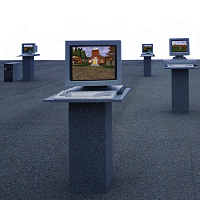 MOST EDUCATORS WORK in brick buildings and the physical world,
but Ed Dieterle prefers a virtual alternative. Dieterle is an advanced doctoral
candidate and researcher at Harvard University (MA). His current
focus is the River City Project, a
multi-user virtual environment (MUVE) that’s similar in look and feel to
The Sims, a popular online simulation game from Electronic Arts. If you were to “visit” River City, you’d discover that it is an interactive
computer simulation of a river town, based in the late 1800s. But it’s
more than that: The system combines digitalized Smithsonian artifacts
with an inquiry-centered curriculum—all to engage middle and high
school students. “The idea is that you ‘step through’ a computer screen and
move into a virtual space,” says Dieterle. “You control an avatar. You’re
participating and collaborating with other people. And you’re communicating
with peers.”
MOST EDUCATORS WORK in brick buildings and the physical world,
but Ed Dieterle prefers a virtual alternative. Dieterle is an advanced doctoral
candidate and researcher at Harvard University (MA). His current
focus is the River City Project, a
multi-user virtual environment (MUVE) that’s similar in look and feel to
The Sims, a popular online simulation game from Electronic Arts. If you were to “visit” River City, you’d discover that it is an interactive
computer simulation of a river town, based in the late 1800s. But it’s
more than that: The system combines digitalized Smithsonian artifacts
with an inquiry-centered curriculum—all to engage middle and high
school students. “The idea is that you ‘step through’ a computer screen and
move into a virtual space,” says Dieterle. “You control an avatar. You’re
participating and collaborating with other people. And you’re communicating
with peers.”
Sound exciting? It is—and River City isn’t the only system of its kind.
Across the globe, progressive universities are embracing any number of
MUVEs, 3D environments, and “immersive” virtual reality tools. And
within the next few months, several universities are expected to test socalled
“telepresence” videoconferencing systems from Cisco Systems and other leading technology companies. By and large,
these solutions promise to eliminate (or at least narrow) the digital
divide, erase international borders, improve distance learning, enhance
collaboration among administrators, and stimulate students’ imaginations.
Tall order. The question is: Can they deliver?
How New Is New?
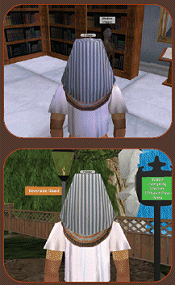
HIGH-TECH G'ES 19TH-CENTURY:
The River City Project combines digitized
Smithsonian artifacts with an engaging
multi-user virtual environment.
Though MUVEs and the like sound
pretty cutting-edge, the fact of the matter
is that virtual environments and 3D systems
have been a work in progress since
at least the early 1960s. Some historians
believe the first computer game, programmed
in 1962, paved the way for
interactive learning (see “Technology
Rewind: A Timeline,” page 33 of our magazine). Other
pundits credit the New York Institute of
Technology with blazing a trail to 3D
computer animation tools: In 1974, the
college launched its famed Computer
Graphics Lab (NYIT CGL), after which
the research group pioneered digital animation
tools for more than a decade.
NYIT CGL’s founders then went on to
launch Pixar Animation Studios, creators of the first fully
computer-animated movies.
Like most technologies, however, 3D
systems, virtual reality, and immersive
environments have suffered their share
of setbacks. In the 1990s, many Silicon
Valley entrepreneurs evangelized the
power of virtual reality (VR). But most
VR systems from that era were either
too limited or too expensive for widespread
deployment. Limitations in computer
storage and bandwidth further
impeded VR’s popularity at the time.
Even basic computer interfaces suffered
throughout the 1990s. Bill Gates,
for one, spoke frequently about “social
interfaces,” wherein users would interact
with characters on a computer screen
in order to navigate basic applications,
like memo writing or e-mail. But
Microsoft’s first
social interface, dubbed Microsoft Bob,
was one of the worst-received products
in the company’s history. Vocal critics
claimed Bob consumed too much PC
memory and power users considered it a
“dumbed-down” user interface.
Next-Gen Teaching Tools: 5 Hot Tips
As you consider next-generation learning
systems, keep this advice in mind:
- Stick with completed standards.
Many wireless vendors that specialize in
mobile learning, for instance, are expected
to promote 802.11n hardware in the
first half of 2007. However, the 802.11n
standard won’t be completed until 2008,
which means current products may not
interoperate.
- Consider hardware appliances. A
growing number of hardware companies
sell specialized multimedia appliances.
Generally speaking, appliances are less
costly to manage because they are
highly reliable and designed for a single
purpose.
- Be skeptical. Many technology consultants
will likely jump on the telepresence
bandwagon. However, true experts
on the technology can be difficult to
find. Only about 14 Cisco Systems partners, for instance, are
currently trained to deploy and support
telepresence.
- Take a tour. Cisco, HP, Polycom, and
other companies are offering telepresence
studio tours across North America. Similarly,
you can register and log on to many
multi-user virtual environments (MUVEs)
to get a feel for 3D learning environments.
- Start small. Don’t forget: In the mid-
1990s, you thought the web was going to
be easy! But a decade later, most universities
are still struggling to organize, maintain,
and protect their websites. The same
trend will likely be true for MUVEs, which
can grow quickly—and just as quickly
become unwieldy.
Turning the Corner
Fast forward to the present, and the situation
is decidedly different. For instance,
the cost to manage and store rich video
information, digitized lectures, and other
multimedia data continues to fall rapidly.
In 1997, the average large data center
paid $1,136 per gigabyte of storage.
Today, the price is closer to $90 per gigabyte,
with some organizations paying as
little as $10 per gigabyte, according to
Computer Economics, a research and advisory
firm specializing in strategic and
financial management of information
systems.
Broadband internet connections have
also become more plentiful across college
campuses and in homes. Roughly
62 percent of US households will have
broadband links by 2010, up from 29
percent in 2005, according to technology
and market research company Forrester Research. And Ed
Golod, president of Revenue Accelerators, a
New York-based tech consulting firm,
asserts, “Rich online learning environments
are finally ready to thrive because
of widely available broadband, cheaper
storage, and faster microprocessors.”
There is deep-seated antagonism toward
games in education. Some educators feel
that anything fun can’t be educational,
which couldn’t be further from the truth.
—Jeff Cooper, Concordia University
Moreover, so-called Web 2.0 technologies—
such as Ajax (Asynchronous
JavaScript and XML)—have empowered
software developers to design rich
internet applications that scale to support
thousands and even millions of
users.
Birth of MUVEs
Those technology trends have paved the
way for next-generation learning systems,
particularly MUVEs such as River City,
Indiana University’s Quest Atlantis 3D
learning environment, the Tapped In online
workplace, and Whyville.
“The benefit of educational MUVEs is
that students will be more motivated to
learn rather than when they are simply
given a textbook to study and test from,”
says Jeff Cooper, an education technology
support consultant for the Tapped In
HelpDesk, and adjunct professor at Concordia
University (OR). “With MUVEs,
learning becomes interactive and studentcentered,
which is in line with the modern
pedagogy of constructivism.”
Generally speaking, MUVEs are distant
cousins of multi-user dungeon
(MUD) games that were first written for
minicomputers in the 1970s. “MUVEs
are a natural progression from MUDs,”
says Harvard’s Dieterle, adding, “but
MUDs were mostly text-driven. Now,
we’ve added graphics and sound to
MUVEs. And instead of slashing and
slaying a dragon, and saving a princess
in a MUD, in a MUVE we show how to
become a scientist.”
All the Right MUVEs
Below, quick snapshots of the MUVEs you should know.
Environment: River City
Backer: Harvard University (MA)
Purpose: 3D immersive learning environment
similar to The Sims video game. Teaches students
reasoning and problem-solving, with an emphasis
on science.
More Info: website
Environment: Whyville
Backer: Independent
Purpose: Social environment that allows students
to make their way within a virtual economy.
More Info: website
Environment: Quest Atlantis
Backer: Indiana University
Purpose: 3D learning environment.
More Info: website
Environment: Tapped In
Backer: SRI International
Purpose: Text-based collaborative environment
where educators support each other and share
best practices.
More info: website
In River City, for instance, students
travel back in time, using their 21stcentury
skills and technology to address
19th-century problems. The students
work together in small research teams to
help the virtual town address health
issues. They keep track of clues that hint
at causes of illnesses; they form and test
hypotheses; they develop controlled
experiments to test their hypotheses;
and they make recommendations based
on the data they collect—all in an online
environment, says Dieterle.
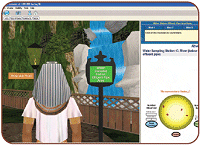
IN RIVER CITY, students learn to become
scientists via avatars in a virtual 19th-century
world. Their every keystroke is captured,
notifying teachers what students do
and don’t know.
“We capture every keystroke that
every student makes,” says Dieterle.
“Students complete activities that are
processed on servers, and e-mail
updates allow teachers to understand
what students do and don’t know. This
allows teachers to guide students
through assessment, rather than putting
kids on the spot with questions.”
In contrast, Whyville is a virtual world
with 1.7 million registered “citizens.”
The system has its own newspaper; its
own senators; its own beach, museum,
City Hall, and town square; its own suburbia;
and even its own economy (citizens
earn “clams” by playing educational
games). “It’s a place where students build
identity,” Dieterle explains.
Although Whyville is designed for
kids, educators foresee a day when similar
MUVEs allow college students to
study economics, social interactions,
criminal justice, and so forth. “The
range of potential applications is practically
limitless,” says Paul Lipsky, an
associate professor at NYIT who specializes
in 3D computer graphics.
Another MUVE, Tapped In, is a text
environment where professional educators
collaborate with one another. Tapped
In offers free professional development
via hundreds of subject-area rooms
(Math Resources, Science Resources,
ESL teachers, etc.), and almost daily
calendared events. “There are also regularly
scheduled tours, and someone is
almost always available on HelpDesk,”
says Cooper.
The Telepresence Tools Are Coming
Below, a sampler of next-generation videoconferencing
solutions.
Solution: Cisco TelePresence
Company: Cisco Systems
Background: May evolve into a solution for university
boardrooms that unites remote campuses.
Price: Up to $299,000 for hardware, plus
$40,000 in deployment costs and $3,000 to
$3,500 per month for maintenance.
Solution: RealPresence Experience (RPX)
Company: Polycom
Background: Seats up to 36 people, making it
a potential solution for distance learning applications
or online learning sessions between
campuses.
Price: $249,000
Solution: Halo Collaboration Studio
Company: Hewlett-Packard
Background: Initially designed for corporate
boardrooms; lower-cost alternatives may target
university administration offices.
Price: Up to $425,000, plus $18,000 per month
per conference room for operating costs.
Remaining Risks
Despite growing interest in MUVEs and
3D learning environments, the technologies
have their limitations.
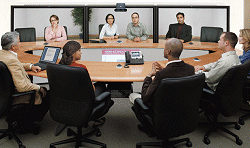
CISCO TELEPRESENCE resembles a virtual boardroom;
life-size images of each participant allow attendees to read body
language, maintain eye contact, and truly interact with peers.
“The real limitation of a MUVE is
that you have to have access to it,” says
Dieterle, “and a lot of components have
to be in place—hardware, a high-speed
network connection, the operating environment—
for everything to work just
right. You can write a great piece of
software, but if it d'esn’t work on
school computers and teachers aren’t on
board, it’s difficult to achieve success.”
Another limitation is psychological in
nature. “Most schools ban anything with
a ‘gaming’ interface or live chat,” says
Cooper. “There is deep-seated antagonism
toward games and anything gamelike
in education. For some reason,
educators feel that anything fun can’t be
educational, which couldn’t be further from the truth.” And as with any internet
site, there are possibilities for abuse, from
students acting out, to sexual predators
logging in. Almost all MUVEs have significant
safeguards to mitigate both risks.
Moreover, MUVEs differ in design
from one another. Certain sites, such as
Tapped In, are open source and may be
freely downloaded and installed. “However,
‘free’ is a relative term,” says
Cooper. “You need programming support
to run any system. I strongly urge educators
to register for existing MUVEs and
try them out, rather than trying to create
their own environment. Reinventing the
wheel is a very difficult thing.”
Picture Perfect?
While 3D computer animation increasingly
dominates MUVEs, digital video is
also taking on a greater role in higher
education. For instance, dramatic improvements
in videoconferencing technology
could set the stage for more
advanced distance learning applications.
Indeed, technology vendors such as
Hewlett-Packard, Cisco
Systems, and Polycom are evangelizing the new “telepresence”
approach to videoconferencing. CT
witnessed the power of telepresence firsthand
during a visit to Cisco Systems’
New York offices in October.
In a typical setting, Cisco’s approach to
telepresence resembles a virtual boardroom.
During the October demonstration,
six executives were seated in a New York
office and another six executives were
seated in a London office. Three 65-inch
plasma screens, digital sound systems,
and carefully placed cameras transformed
the two physical rooms into one
virtual boardroom.
Cisco TelePresence delivers
life-size images of each participant,
ensuring that it’s easy to
read attendees’ body language,
maintain eye contact, and truly
interact with peers across the table—
regardless of their physical location.
Gone are the days of pan/tilt/zoom cameras,
muffled speaker phones, and tubebased
TVs that don’t capture the finer
nuances of nonverbal communication.
Instead of slapping together thirdparty
technology, Cisco spent two years
designing and refining its TelePresence
system. Everything in a TelePresence
room—from the plasma screens to the
microphones—carries Cisco’s logo.
Even the accompanying furniture was
designed by the TelePresence team. It’s
as if Cisco studied Apple and that company’s commitment to
the total user experience.
The Cisco TelePresence system will
likely appeal to university presidents
who seek to communicate with remote
trustees. The current Cisco products are
designed for small group settings, typically
12 people or fewer. By contrast,
Polycom’s solution supports up to 36
people and its layout resembles a small,
specialized lecture hall.
Technology Rewind: A Timeline
While multi-user virtual environments (MUVEs) and 3D learning systems sound
futuristic, their roots stretch back nearly 60 years.
1950s. In 1958, President Eisenhower requested funds that ultimately paved
the way for ARPANet (Advanced Research Projects Agency Network), the precursor
to the internet.
1960s. Some pundits argue that computer-based learning was born in 1962, when
a young programmer from MIT, Steve Russell, created the first computer game. Dubbed
Spacewar, the game was written on a PDP-1, an early minicomputer from Digital Equipment
(now part of Hewlett-Packard). Spacewar is similar to Atari’s famed Asteroids game from the 1970s, but instead of shooting asteroids,
players in Spacewar took aim at each other’s space ships. The Spacewar project, which
took about 200 man-hours to complete, inspired students and professors alike to
examine how computers would revolutionize learning on college campuses.
1970s. In the 1970s, early computer adventure games such as Adventure (1973),
Zork (1977), and MUD (Multi-User Dungeon, 1978) paved the way for MUVEs,
according to the Summary of MUD History.
1980s. MUDs began to make the transition from combat-oriented games into
learning systems in 1989, when a game called TinyMUD debuted on Unix systems. TinyMUD, written by Carnegie Mellon University (PA) graduate student
Jim Aspnes, focused on virtual problem solving, user cooperation, and social
interaction among the MUD visitors.
1990s. By the time the World Wide Web went live in 1993, universities finally had
the perfect storm for online learning: Graphical user interfaces on a global web of
interconnected PCs. Still, rich visual learning tools take time to get right. Many of the
first true videoconferencing systems surfaced in the 1990s, but they were clunky,
expensive, and built on proprietary hardware and software. Proprietary systems have
since given way to industry-standard offerings.
Today... Modern standards such as voice over IP (VoIP), Gigabit Ethernet, and session
initiation protocol (SIP) provide a foundation for fast, reliable, and even mobile
learning solutions.
Mobile Telepresence
Meanwhile, HP has its own take on telepresence,
known as Mutually-Immersive
Mobile Telepresence. HP Labs is designing
technology that will give professors,
researchers, or administrators the sense
that they are truly present in a remote
place, such as a boardroom or lecture hall.
The ultimate goal, according to HP
Fellow Norm Jouppi, is “to give you the
ability to catch the eye of someone in the
room, or even whisper an aside to them—
without you having to be there at all.”
With this goal in mind, HP Labs has
created what it calls a surrogate: a
machine that d'es the traveling for you.
This robot-like device’s mobility rivals
that of a state-of-the-art wheelchair.
The system carries sets of cameras and
microphones that give a 360-degree
audio and video view of its surroundings,
while displaying your head on four
flat-panel displays.
HP hasn’t disclosed if or when it will
release the robot-like device. However,
the company has introduced telepresence
technology known as the HP Halo Collaboration
Studio. HP, much like Cisco
and Polycom, is initially targeting Global
2000 companies with the boardroom-like
system. Early adopters include PepsiCo,
Advanced Micro Devices, and Dream-
Works. Longer term, HP also expects
major universities to test and possibly
deploy the system.
Big Potential, Big Challenges
Sales of telepresence systems are just
underway now but are expected to reach
$300 million by 2008, according to
Gartner IT analysts.
Despite their power, telepresence systems
will face their share of challenges.
First, there’s the price tag. HP’s Halo
Collaboration Studio can cost as much
as $425,000, plus operating costs of
$18,000 per month per conference
room—well beyond the budgets of most
universities. Polycom’s RealPresence
Experience (RPX) telepresence systems
cost as much as $249,000. And Cisco’s
highest-end offering checks in at
$299,000, plus $40,000 in deployment
costs and roughly $3,000 to $3,500 in
monthly maintenance costs.
Some universities aren’t intimidated
by the hefty price tags and maintenance
fees, however. Sources say Harvard, for
one, contacted Cisco multiple times
about beta testing the company’s telepresence
offerings, prior to the Cisco
TelePresence launch in October.
Yet, cost isn’t the only hurdle facing
telepresence systems. Universities may
also need to upgrade their data centers
and wiring closets to make telepresence
function. A typical, high-quality telepresence
session requires anywhere
from 2Mbps to about 10Mbps of dedicated
bandwidth between locations,
Cisco concedes, and some remote locations
simply don’t have that type of
bandwidth available yet. What’s more,
universities will need a modern voice
over IP (VoIP) switching infrastructure
to make everything work. The final challenge
involves the installation: Only
about 14 Cisco partners, for instance, are
trained to install telepresence solutions
(although the company claims more
partners are coming online rapidly).
Still, while next-generation learning
systems are sometimes cost-prohibitive,
it’s a safe bet that telepresence and
immersive learning systems will become
increasingly affordable as time moves
forward. Consider, for instance, trends in
the plasma TV market. Over the past two
years, plasma TV prices have dropped
more than 50 percent, according to multiple
research firms. Ultimately, that kind
of downward trend will allow telepresence
to make the jump from corporate
boardrooms to university campuses.
WEBEXTRA :: Harvard’s Chris Dede on technology change in education Click here.