2008 Campus Technology Innovators: Interactive, Remote Learning
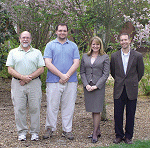
FURMAN'S VIRTUAL TOUR development team (left to right): Academic Computing
Specialists Wade Shepherd and Cort Haldaman, and Instructional Development
Consultants Diane Boyd and Mike Winiski.
TECHNOLOGY AREA: INTERACTIVE, REMOTE LEARNING
Innovator: Furman University
One history professor experiments with technology
to transport his students through space and time,
and interact with them as he guides them through
remarkable field trips they may never have been able
to experience otherwise.
So much to see, so little time. From a logistical perspective, field
trips for departments with limited resources can be challenging.
Such was the driving force behind Tripping Virtually (Interactive
Field Experiences in Urban History), a new IT effort at Furman
University (SC) involving technologists from a number of
departments, to enable student field trips that are transporting
interactive experiences-- without ever leaving campus.
The results of the project are inspiring. This April, from their
classrooms in Greenville, SC, Furman students participated in
virtual walking tours of historical sites in cities such as Boston
and New York. As their professor wandered the streets of
these cities hundreds of miles away, students followed along
in real time via images, audio, and geocoded displays courtesy
of Google Maps. Later, with the
help of Camtasia Studio from TechSmith, the students were able to access the archived tours for
study purposes.
Professor T. Lloyd Benson (the Walter Kenneth Mattison
Professor of History) needed only a few months to develop
his unique curriculum. Eager to create a fully interactive virtual
field trip complete with integrated mapping from a remote location, Benson set out in early 2007 to find technologies
that could do the job.
With the help of colleagues in the school's Computing and
Information Services department and the Center for Teaching &
Engaged Learning, Benson selected a nucleus of off-the-shelf
technologies such as the HP iPAQ hw6940
Mobile Messenger with built-in GPS, as well as technologies,
products, and services from NEC, Verizon, Vonage, AT&T Wireless, Apache, IBM, Shure, Da-Lite,
and JBL. Total price tag: $1,000.
Thanks to SAILOR, Harford
advisers were able to see
8 percent more students in
the spring 2008 semester
than in the previous fall.
Once the equipment and tools were in place, Benson wrote
a Python script in Keyhole Markup Language
(KML) that would read location information embedded
in the uploaded images, transfer those images to Google Maps
and Google Earth, and create a dynamic
web gallery that displayed the images in an interactive geographic
context. This enabled students to see images of exactly
what their professor was seeing as he moved around.
(Benson also made this script available to other educators who
wished to duplicate the configuration.)
The immediacy of these tours was striking. Instead of sitting
and watching a slide show, students became involved in
directing the tour-- on numerous occasions telling Benson
where to go and what to do. However, since both wireless cell
phone and GPS technologies were used, the class also
learned that in order for these technologies to work, users
must be sure signals are strong. At one point, for example,
Benson passed a courthouse that was jamming cell phone
signals and he was briefly lost to his class.
The real-time nature of these lessons won students over
quickly. According to Benson, students noted in subsequent
surveys that the experience enriched their learning through
real-time interactions with a tour guide, and that the cities
"came to life." The students also said that as a result of the live,
"you are there" lessons, they had a better sense of historical/
spatial connections.
Wade Shepherd, director of the university's Computing and
Information Services department, says Benson plans to
broaden this curriculum and incorporate it in future classes so
more of his students can collaborate with him and with undergraduates
in travel/study abroad programs. Farther down the
road, he envisions a situation where students at different
schools can swap tours.
"We think the fact that this can be done with inexpensive
tools totaling about $1,000 will make this approach an easily
adoptable solution for all kinds of similar projects and even for
inter-institutional and K-12 collaborations," says Shepherd.