2008 Campus Technology Innovators: Mobile Learning
TECHNOLOGY AREA: MOBILE LEARNING
Innovator: Abilene Christian University
With smart phones and similar devices, students can compute easily anywhere, and leave the laptops back at the dorm or at home.
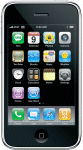
It's no secret that smart phones are the wave of the mobile device future, and at Abilene Christian University (TX), technologists recently embarked on an effort to embrace this technology and deploy an iPhone program that connects students and faculty through academic, social, and infrastructure applications.
The program, dubbed ACU Connected, will debut this fall with more than 1,000 students and faculty receiving either iPhone or iPod Touch tools from Apple, to use as mobile computing devices. These devices, empowered by wireless service from AT&T and applications from Google Apps, will enable students to leave their laptops at home when they go to class. According to George Saltsman, director of educational technology at ACU, applications of the tools will vary, but many educators have received training in mobile learning design and are calling upon this new knowledge to develop curricula that incorporate the phones to handle podcasts, flashcards, polls, and live assessment for use in classes across the university. Saltsman adds that the pilot will focus on freshmen and first-year students. The goals: to make computing easier for students, and to strengthen enrollment and retention as a result.
"We gain the advantages of oneto- one computing in the classroom, without the bulk and limited battery life of laptops," he says. "Faculty [members] will have access to a new teaching 'space' that is mobile, ubiquitous, and converged, while students receive access to campus services and learning materials, regardless of location."
As cohesive as it sounds, the project didn't come together overnight. Faculty members at ACU had been considering mobile broadband as a revolutionary new computing platform since 2002, and previously had looked into BlackBerry devices from Research in Motion and Treos from Palm, to support a campuswide program. But the efforts were stalled until 2007, when-- following the release of Apple's iPhone and the publication of the 2008 Horizon Report, which charted the landscape of emerging technologies for teaching, learning, and creative expression-- faculty members became excited at the possibilities. Nearly 40 faculty members and technologists were involved in researching a solution around the new platform. Heading the project was Bill Rankin, director of mobile learning and professor of English, who worked with key team contributors Kevin Roberts, CIO; James Langford, director of web integration and programming; Jim Trietsch, associate CIO; and Kyle Dickson, co-director of mobile learning research and podcasting. By the end of the 2007-2008 school year, the Connected program was ready to roll.
The new program launches this fall, and certain details (such as additional vendors) and upgrades to the wireless network are still in the works. Internal marketing on the program is already in place. To help students (and other faculty members) prepare for the deployment, faculty and education technologists have communicated their vision through a special blog, a unique mobile learning web portal, and a student-produced film that, as of May 15, had been downloaded more than 25,000 times.
Rankin says that while this film has helped introduce newcomers and potential business partners to the program, the process of developing it yielded some unforeseen benefits as well: The video has encouraged faculty and students to re-imagine the learning process in bold new ways, and to buy into that vision earlier than they may have otherwise. "One strength of moving mobility at ACU has been putting educators and developers in the same room," says Rankin.
Still, not everybody is enthusiastic about the program. When ACU upperclassmen heard about plans to launch the Connected program with freshmen only, they protested on tech blogs and Facebook. The protests subsided only when the university announced plans to expand the program down the road.