Students Prepare Rockets for NASA-Boosted Mile-High Launch
- By Dian Schaffhauser
- 01/09/12
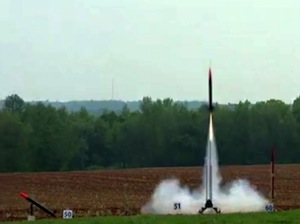
A rocket, designed and built by students, is launched during last year's Student Launch Initiative. |
In spite of recent cutbacks the American space program is alive and thriving--at least for students. More than 500 middle school, high school, and college students will test their rocket prowess as part of a special NASA program. The NASA Student Launch Projects challenges teams of students to build and test large-scale reusable rockets of their own design. Launch takes place in April 2012.
The experience is designed to allow students to demonstrate proof-of-concept for their rocket designs and helps turn abstract classroom lessons into tangible activities. The ultimate goal: to design and build a rocket that can haul a payload up as close as possible to an altitude of one mile.
On the K-12 side, 15 middle school and high school teams will participate in the non-competitive Student Launch Initiative. On the higher ed side, 42 college and university teams will compete in the University Student Launch Initiative for a number of prizes, including a $5,000 first-place award put up by ATK Aerospace Systems in Salt Lake City.
During the year-long process, teams must document the progress of their work by writing detailed preliminary and post-launch reports and maintaining a public website for their rocket-building efforts. Teams must also concoct educational projects for schools and youth groups in their areas to "carry forward" their interest in rocketry.
As the teams progress in their work, students get an education in risk management, project management, chemistry, physics, engineering, hazardous materials handling, and even government procurement practices.
During the April launch, the teams meet up at a farm near NASA's Huntsville, AL-based Marshall Space Flight Center, where NASA engineers will put the student rockets through the same kind of rigorous reviews and safety inspections applied to full-sized vehicles that are expected to go into space. On April 21, after a day of workshops, students will attempt to fire their rockets toward the one-mile goal, operating onboard payloads and waiting for parachutes to open, signaling a safe return to Earth.
Success isn't assured. During the 2010-2011 challenge, the rockets of two of the 17 K-12 teams didn't get off the ground. Among the college entries, six of 33 failed to launch.
"This competition is extremely important to ATK to mentor and train our future workforce," said Charlie Precourt, general manager and vice president of the company's Space Launch Systems division. Precourt is a former space shuttle astronaut who piloted STS-71 in 1995 and commanded STS-84 in 1997 and STS-91 in 1998. "ATK is proud to enter our fifth year as a partner with NASA on this initiative to engage the next generation. The competition grows in impact each year."
Awards will be given in a number of areas, including display of engineering skill and ingenuity, team spirit, and vehicle design. Tektronix has donated two of its TDS2000 Series oscilloscopes to be awarded to the teams that earn the "Best Payload" and "Best Science Mission Directorate Challenge Payload" honors.
The NASA Student Launch Projects are sponsored by NASA's Human Exploration and Operations Mission Directorate, Science Mission Directorate, and Office of Education Flight Projects.
About the Author
Dian Schaffhauser is a former senior contributing editor for 1105 Media's education publications THE Journal, Campus Technology and Spaces4Learning.