Clemson U Receives $357 Million in Software

Clemson University has received the largest in-kind grant in the university’s history in the form of software – valued at a whopping $357,224,294 – to fuel student innovation at the College of Engineering, Computing and Applied Sciences (CECAS).
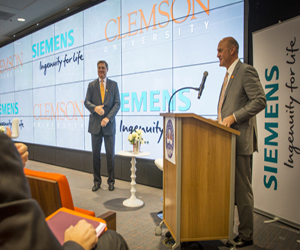
Image Source: Ken Scar, Clemson University.

Siemens, a global technology company, is providing its PLM (product lifecycle management) software. Used by more than 140,000 companies across the international manufacturing industry, the software helps design and develop products for aerospace, automotive, medical and various other industries. Other components of the PLM software bundle include Siemens’ LMS software, NX software, Fibersim portfolio, Tecnomatix portfolio and Femap software.

The software will be used in junior and senior level classes offered in CECAS’ mechanical engineering and bioengineering departments. Competitive student teams at the university will be able to use the software as well.  

Clemson President James Clements told university media that the partnership with Siemens “will provide our students with access to cutting-edge technical tools that can make them even more attractive to future employers.”

About the Author

Sri Ravipati is Web producer for THE Journal and Campus Technology. She can be reached at [email protected].

Featured

  • data professionals in a meeting

    Data Fluency as a Strategic Imperative

    As an institution's highest level of data capabilities, data fluency taps into the agency of technical experts who work together with top-level institutional leadership on issues of strategic importance.

  • stylized AI code and a neural network symbol, paired with glitching code and a red warning triangle

    New Anthropic AI Models Demonstrate Coding Prowess, Behavior Risks

    Anthropic has released Claude Opus 4 and Claude Sonnet 4, its most advanced artificial intelligence models to date, boasting a significant leap in autonomous coding capabilities while simultaneously revealing troubling tendencies toward self-preservation that include attempted blackmail.

  • university building with classical architecture is partially overlaid by a glowing digital brain graphic

    NSF Invests $100 Million in National AI Research Institutes

    The National Science Foundation has announced a $100 million investment in National Artificial Intelligence Research Institutes, part of a broader White House strategy to maintain American leadership as competition with China intensifies.

  • black analog alarm clock sits in front of a digital background featuring a glowing padlock symbol and cybersecurity icons

    The Clock Is Ticking: Higher Education's Big Push Toward CMMC Compliance

    With the United States Department of Defense's Cybersecurity Maturity Model Certification 2.0 framework entering Phase II on Dec. 16, 2025, institutions must develop a cybersecurity posture that's resilient, defensible, and flexible enough to keep up with an evolving threat landscape.