Smart Assistants Helping to Drive Growth of Wearables

Wearable devices will continue to see healthy growth over the next five years, driven by new use cases, new devices and the rise of smart assistants.

According to a new report released by IDC, wearables will increase 15.3 percent worldwide in 2019 compared with 2018, with 198.5 million units expected to be shipped this year. IDC forecast smaller but still substantial annual growth (8.9 percent) through 2023, when shipments are expected to hit 279 million units.

Watches made up 44.2 percent of shipments in 2018 and are expected to account for an even larger percentage of the market by 2023, 47.1 percent. But headsets/ear-worn devices will have a major impact on that growth with the rise of smart assistants, reaching 31 percent of the market by 2023.
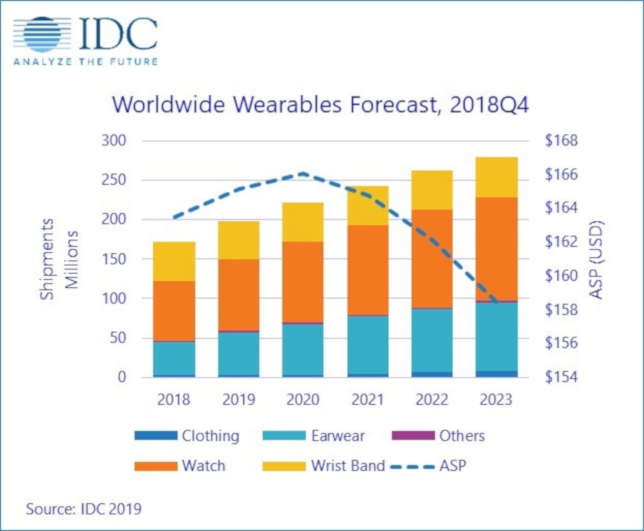
Wearable devices will continue to see healthy growth over the next five years, driven by new use cases, new devices and the rise of smart assistants.  

"The rise of smart assistants on wearables, both wrist-worn and ear-worn, is a trend worth watching," said Jitesh Ubrani, research manager for IDC's Mobile Device Trackers, in a prepared statement. "Though still in its infancy, the integration of these assistants with wearables opens up new use cases, from allowing these devices to tie into the smart home to making the devices more proactive at urging users to live healthier or more productive lives."

"Two major drivers for the wearables market are healthcare and enterprise adoption," said Ramon T. Llamas, research director for IDC's Wearables team, also in a prepared statement. "Wearables stand to play an important role in digital health, constantly collecting important patient data while also giving patients the ability to self-monitor. Within the enterprise, wearables can help to accelerate companies' digital transformation by transmitting information back and forth while allowing workers to complete their tasks faster. This is where both vendors and companies can streamline processes to achieve faster results."

About the Author

David Nagel is the former editorial director of 1105 Media's Education Group and editor-in-chief of THE Journal, STEAM Universe, and Spaces4Learning. A 30-year publishing veteran, Nagel has led or contributed to dozens of technology, art, marketing, media, and business publications.

He can be reached at [email protected]. You can also connect with him on LinkedIn at https://www.linkedin.com/in/davidrnagel/ .


Featured

  • college students sitting with laptops at an outdoor table

    How Colleges Are Building More Connected and Responsive Student Support

    Colleges are making steady progress in building more connected and responsive student support systems. By aligning services and improving coordination, institutions are enhancing both the student and staff experience.

  • Abstract digital cloudscape of glowing interconnected clouds and radiant lines

    Cloud Complexity Outpacing Human Defenses, Report Warns

    According to the 2026 Cloud Security Report from Fortinet, while cloud security budgets are rising, 66% of organizations lack confidence in real-time threat detection across increasingly complex multi-cloud environments, with identity risks, tool sprawl, and fragmented visibility creating persistent operational gaps despite significant investment increases.

  • Woman in tech, illuminated by blue data light

    Transforming Research Data Management for Greater Innovation

    Institutions that want to maximize their research investments need a strategic management approach that balances preservation, accessibility, and security and satisfies stakeholders' needs at the same time.

  • Wireless network and connection abstract data background with wifi symbol

    Georgetown Partners with Cisco on Large WiFi 7 Rollout

    Georgetown University is working with Cisco on a multi-year network revamp that will implement WiFi 7 across the institution's classrooms, dorms, stadiums, and beyond.