OER Commons Intros Authoring Tool

OER Commons authoring tool

OER Commons' Open Author

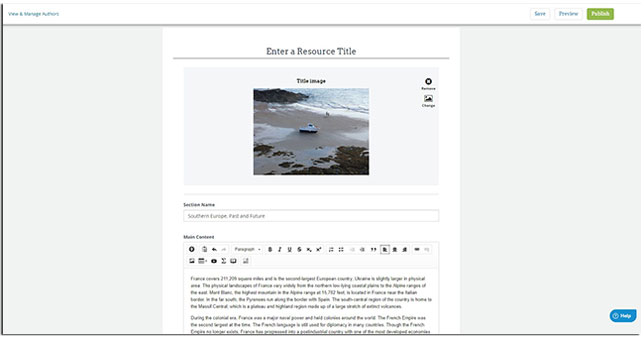
An organization focused on creating open educational resources for education has developed a new tool for authoring OER. OER Commons' Open Author, as it's named, consolidates the functions of three other utilities from OER Commons: the Resource Builder, Lesson Builder and Module Builder.

The program features:

  • A what-you-see-is-what-you-get editor with an accessibility checker, copy and paste from Word and Excel, and a straightforward math editor;
  • Tools for including images, with alt text and captions;
  • Download options for PDF, EPUB3, SCORM and Thin Common Cartridge files;
  • Import from Google and Microsoft OneDrive; and
  • The ability to include a co-author.

During content development, the author can view the material as either an instructor or learner would see it.

For members of the OER Commons' community, existing materials are still available (through the My Items or Groups spaces).

Once the material is ready for publication, others can remix the resource and use it with other materials.

The organization reported that it would be updating its published views in early 2020.

About the Author

Dian Schaffhauser is a former senior contributing editor for 1105 Media's education publications THE Journal, Campus Technology and Spaces4Learning.

Featured

  • CIS Sandbox Tutor Eli Blouin at Bentley University imagines a future technology learning partner that supports curiosity, critical thinking, feedback, and personalized learning.

    Student Voices: Technology as a Future Learning Partner

    A data analytics and marketing major at Bentley University and a distinguished lecturer at the university explore the future of "technology learning partners" — technologies that participate in the learning process by asking questions and giving feedback, not just information search results.

  • Abstract energetic glowing lines with particles

    Meta Steps Up Enterprise AI Ambitions with Muse Spark Launch

    Meta has announced the launch of Muse Spark 1.1, a multimodal reasoning model designed for agentic AI, alongside a new Meta Model API that gives developers access to the model for the first time.

  • Businessman using laptop analyzing data and growth graph chart

    AI Budgets in Education Show No Sign of Decline

    The vast majority of education organizations (98%) expect their AI infrastructure budgets to either increase or hold steady over the next year, according to a recent report from cloud storage provider Wasabi.

  • Dana Brunson facilitates a roundtable discussion with research and higher education IT leaders

    Internet2: Closing the Access Gap for Research Cyberinfrastructure

    Internet2's Research Engagement Team brings CIOs and other campus technology leadership together with research computing and data facilitators, forming a community that enables research cyberinfrastructure at institutions of all types and sizes.