Arizona State Partnership to Embed VR into Intro Biology Courses
- By Dian Schaffhauser
- 10/07/20
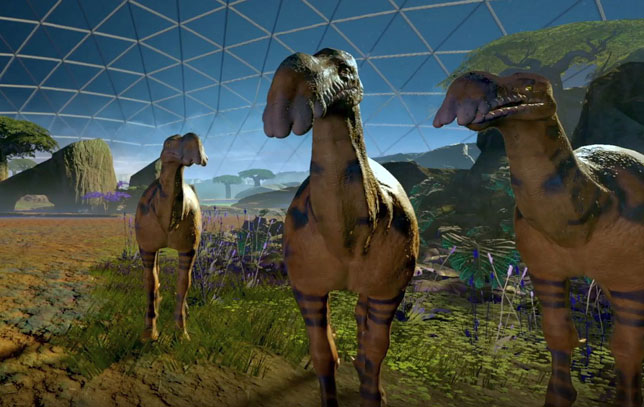
Dreamscape's Alien Zoo
As early as next year, students at Arizona State University could be able to don a headset, sensors and a light knapsack and immerse themselves in a theme-park-like visit to an alien zoo. The university has struck an agreement with Dreamscape Immersive to bring the latter's virtual reality technology to campus.
Dreamscape, the brainchild of computer scientists and Hollywood creatives, physically immerses small groups of people into a computer-generated world, blending motion and storytelling. The company normally has operations in four cities: three in the United States, and one in Dubai. (The U.S. locations are shuttered currently.)
It has developed three "adventures":
- "Alien Zoo," a wildlife refuge for intergalactic creatures on the verge of extinction;
- "The Blu," an underwater plunge where participants help to reunite a family of whales; and
- "Curse of the Lost Pearl," an adventure to hunt down a lost pearl and break an ancient curse.
The deal with Arizona State will start with Alien Zoo, which will be added to introductory biology courses for students on campus and online. Working independently or in teams, students will grapple with issues arising in real wildlife refuges on Earth, such as treating infectious diseases, managing genetic diversity and balancing food webs. In doing so, they'll also complete the required course work for introductory biology in a new, experiential way.
The partnership will include the establishment of immersive, experiential Dreamscape Learn Labs on Arizona State campuses, where students will work with science, arts and engineering faculty to solve problems, explore and engage with virtual worlds and spaces designed for specific courses and disciplines.
"We've always known there is huge potential to unlock new learning realms for students by merging VR — and all that it empowers educationally and socially — with advanced, adaptive educational experiences," said university President Michael Crow, in a press release. "Through Dreamscape Learn, students of all ages will be able to explore completely different worlds and perform complex learning, discovery and problem-solving tasks that you wouldn't be able to do in a traditional learning environment or lab in a campus setting."
Added Dreamscape CEO Walter Parkes, "We believe that 2020 will be seen as an inflection point in the history of education — the moment when society recognized it had both the urgent need and the digital tools to provide first-class educational experiences remotely to a previously unimaginable number of students in previously unimaginable ways. We intend for Dreamscape Learn to be a uniquely important educational asset moving forward."
Dreamscape Learn is expected to be available to students in 2021, with "rapid expansion" into other subjects by 2022.
About the Author
Dian Schaffhauser is a former senior contributing editor for 1105 Media's education publications THE Journal, Campus Technology and Spaces4Learning.