Savvy WiFi Savings
- By Linda L. Briggs
- 12/01/08
How one university saved thousands of dollars by beefing up
low-end access points with more powerful open source firmware.
The following article, "Open Source Brings Down Cost of
Wireless Rollout", appeared on our website on Aug. 13, 2008.
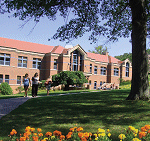
ALFRED U’s innovative WiFi solution has saved between $38k-$88k in APs alone.
AS ANY IT ADMINISTRATOR KNOWS, wireless deployments
can be costly. On the other hand, with students
demanding on-the-go access, pervasive WiFi networks are
a must on campus.
One creative way to keep the cost down is to buy relatively
inexpensive, low-end access points (APs), then
upgrade the firmware to more powerful open source
firmware, before installation. Alfred University, a 2,300-student school in upstate New York, has saved tens of
thousands of dollars by doing just this; it has rolled out several
hundred "upgraded" enterprise-grade 802.11g APs
so far, and plans to continue with more.
By taking consumer-grade APs and beefing them
up with free, enterprise-level open source firmware,
Alfred U has been able to create inexpensive 802.11g
APs with many of the features and capabilities of a
much costlier product. The school's bottom line: the
need to avoid spending perhaps a quarter of a million
dollars on a major wireless upgrade, only to end up
with a system that could be obsolete in five years as
wireless standards continue to evolve.
Enterprise-Grade Wireless
on the Cheap
Before the open source project, the Alfred campus
was wireless in its most heavily used public areas.
Dorms, however, were hardwired with a "port-per-pillow"
scheme. When students informed the administration
via a survey that they wanted wireless in the
dorms, IT Services Director Gary Roberts says he
challenged his team to come up with a wireless solution
that would be both powerful and affordable. They
came up with an unusual solution, and after successful
testing last year in several locations, Roberts
and his staff launched the project by rolling out nearly
200 access points in a few months.
"I basically wanted to find the most cost-effective
solution," Roberts says. Using the less-expensive consumer-
grade APs saved hundreds of dollars per unit. The
university purchased about 200 APs for this project, at
about $60 per unit, and has rolled out most of them, saving
the remainder for any coverage gaps they may discover over
time. Since a more traditional wireless solution can cost
$250 to $500 or more per AP, Roberts figures he saved
somewhere between $38,000 and $88,000 in access
points alone.
Alfred's original wireless network consisted of Linksys consumer-grade 802.11b APs, implemented
years ago. The school planned to upgrade and
expand the entire wireless network to 802.11g when
Roberts and his team hit on the open source solution.
The open source firmware for the new wireless system is
called DD-WRT, free Linux-based firmware designed to work with a number of vendors'
access points. The university chose consumer-grade
APs from Buffalo Technology,
per recommendations on the DD-WRT website.
The wireless network, which Roberts points out isn't
intended for voice over IP (VoIP) or heavy streaming video
use, runs at about 2 Mbps under worst-case situations. When
the university is ready for VoIP or other big-bandwidth uses,
he says, he'll explore additional options. Meanwhile, Roberts
expects the solution "will hold us for a couple of years."
Implementation of the new system involves "flashing" each
AP's firmware, or loading a new operating system onto each
device. Without careful handling, Roberts concedes, the
process can destroy an AP. But he reports that in the
process of flashing 160-some devices, he and his staff lost
just a handful—acceptable odds, he says, given the low
price of each AP.
In all, Roberts spent $12,000 for access points, and an
additional $15,000 on power drops to bring power to the
APs. His final price tag: $27,000. "We actually came in
under budget," he boasts.
Other Benefits
Another advantage of open source: Changing to the DDWRT
firmware allowed Roberts' staff to write an SSH script
that controls all the access points from a central server, allowing
IT to remotely turn off all the APs once a week, in the wee
hours of the morning, to "flush" the systems. (Although
expensive enterprise-grade access points often offer that
kind of central control, unaltered consumer-grade APs don't.)
Running DD-WRT also allows the IT staff to boost the
power of each AP if necessary, something that helps an AP
which needs more range because of its location. (Again,
that's not a common feature on a consumer-grade AP.) The
university also has been able to write a script to automatically
generate an alert when an access point goes down.
That's possible because with the DD-WRT firmware, each
AP is assigned a static AP address.
Finally, the combination of Buffalo access points and
DD-WRT provides automatic channel selection. That
means that if APs overlap, Roberts' staff can set them to
avoid conflicts, using channel 1, 6, or 11 to avoid frequency
collisions, because each AP can detect the others.
:: RelatedLinks ::
Wayne State University (MI) Upgrades to Next-Generation
Wireless Networking
Saint Joseph's (PA) Builds out Wireless Network in Multi-Year Upgrade