Annual Conference Highlights : Campus Technology 2009
This year’s annual summer conference, held in July in Boston, reflected IT trends at higher education institutions and
was a chance for attendees to explore Web 2.0 technologies, social software, smart classrooms, new instructional
media, and more. Here, we share some images of this inspiring and productive event.
A Meeting of Minds: The Executive Summit
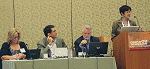
 An invitational summit brought together higher
education technology leaders for a daylong
discussion of technology and leadership. Joan
Falkenberg Getman of Cornell University (NY) led
three plenary panels on emerging technologies,
societal trends, and leadership. Discussion
panelists pictured (above, left to right): Julie
Smith, CDW-G; Aaron E. Walsh, the Media Grid;
Phil Long, The University of Queensland
(Australia); with moderator Getman.
An invitational summit brought together higher
education technology leaders for a daylong
discussion of technology and leadership. Joan
Falkenberg Getman of Cornell University (NY) led
three plenary panels on emerging technologies,
societal trends, and leadership. Discussion
panelists pictured (above, left to right): Julie
Smith, CDW-G; Aaron E. Walsh, the Media Grid;
Phil Long, The University of Queensland
(Australia); with moderator Getman.
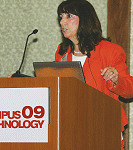 Project Tomorrow
leader Julie Evans
(left) gave a luncheon
keynote focusing on
the upcoming
generations of
college students,
including the “free
agent” learner.
Project Tomorrow
leader Julie Evans
(left) gave a luncheon
keynote focusing on
the upcoming
generations of
college students,
including the “free
agent” learner.
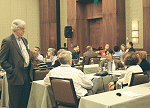 Afternoon
discussion
workgroups were led
by Chris Dede of
Harvard (MA). In
small groups,
summit participants
personalized the
day’s experiences by
talking with peers
about technology
customization at
their own
institutions.
Afternoon
discussion
workgroups were led
by Chris Dede of
Harvard (MA). In
small groups,
summit participants
personalized the
day’s experiences by
talking with peers
about technology
customization at
their own
institutions.
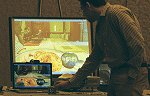 A “technology sandbox” gave summit
participants hands-on time with current
products supplied by sponsor CDW-G and
a just-launched immersive mixed reality
product courtesy of the Media Grid.
A “technology sandbox” gave summit
participants hands-on time with current
products supplied by sponsor CDW-G and
a just-launched immersive mixed reality
product courtesy of the Media Grid.
Thought-Provoking
Keynotes and Sessions
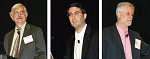 Chris Dede gave the opening keynote on emerging
interactive media and their implications for teaching
and research. Aaron E. Walsh, one of the 11 Campus
Technology Innovator awardees for 2009, spoke in his
keynote session about immersive technologies and
their potential impact on education. Phil Long’s
closing keynote was an intriguing glimpse into one
education technology leader’s own global IT journey.
Chris Dede gave the opening keynote on emerging
interactive media and their implications for teaching
and research. Aaron E. Walsh, one of the 11 Campus
Technology Innovator awardees for 2009, spoke in his
keynote session about immersive technologies and
their potential impact on education. Phil Long’s
closing keynote was an intriguing glimpse into one
education technology leader’s own global IT journey.
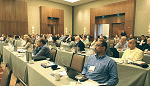
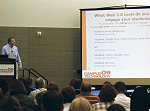
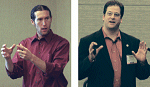 Breakout and workshop session topics ran the gamut from briefings on
the latest social software tools to in-depth examinations of technology
infrastructure. Mark Frydenberg of Bentley University (MA) presented a
breakout session on how to engage millennial students, and attendees
used Web 2.0 tools interactively during the session (below left). Stanford
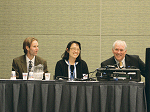
University’s (CA) Academic Technology Specialist Menko Johnson and
research scientist Helen Chen joined a panel moderated by Director of
Technology Services Bob Smith on “Supporting Technically-Facilitated
Intercultural Classes” (below right, left to right). In two seminars delivered by
virtualization expert Greg Shields (above far left), attendees could get a half-day
crash course on virtualization and opt to continue for the rest of the day to take a “deep dive” into the topic. And Josh
Baron (above left) of Marist College (NY) gave a breakout session to update attendees on Sakai, and later led a panel
discussion and open forum on open education.
Breakout and workshop session topics ran the gamut from briefings on
the latest social software tools to in-depth examinations of technology
infrastructure. Mark Frydenberg of Bentley University (MA) presented a
breakout session on how to engage millennial students, and attendees
used Web 2.0 tools interactively during the session (below left). Stanford
University’s (CA) Academic Technology Specialist Menko Johnson and
research scientist Helen Chen joined a panel moderated by Director of
Technology Services Bob Smith on “Supporting Technically-Facilitated
Intercultural Classes” (below right, left to right). In two seminars delivered by
virtualization expert Greg Shields (above far left), attendees could get a half-day
crash course on virtualization and opt to continue for the rest of the day to take a “deep dive” into the topic. And Josh
Baron (above left) of Marist College (NY) gave a breakout session to update attendees on Sakai, and later led a panel
discussion and open forum on open education.
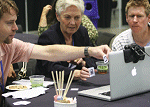 Attendees
enjoyed in-depth
conversations with
CT Innovator
award winners
during a Birds of a
Feather luncheon,
exploring
technologies
and tech topics
informally.
Attendees
enjoyed in-depth
conversations with
CT Innovator
award winners
during a Birds of a
Feather luncheon,
exploring
technologies
and tech topics
informally.
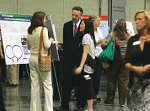 Numerous poster sessions provided an
array of choices to fit every information
need at the conference.
Numerous poster sessions provided an
array of choices to fit every information
need at the conference.
A Buzzing Exhibit Hall
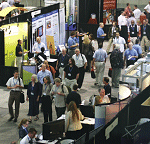 A busy exhibit hall demonstrated that Campus
Technology 2009 remained prosperous even in a
challenging economy—the place to be to learn and
share knowledge about IT in higher education.
A busy exhibit hall demonstrated that Campus
Technology 2009 remained prosperous even in a
challenging economy—the place to be to learn and
share knowledge about IT in higher education.