Washington and Lee Tech Staff Welcome New Students with QR Codes

QR code-clad IT staffers greeted new Washington and Lee students this fall.

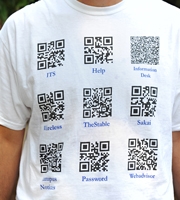
Recently, the tech staff at Washington and Lee University turned into walking QR billboards to welcome new students to its Lexington, VA campus. While staffing first-year check-in and orientation, members of the university's IT Services team wore custom t-shirts they'd had printed up with useful QR codes.

QR, short for quick response, is a two-dimensional barcode designed to be read by smart phones.

The t-shirts provided a quick way for students to scan the codes to load handy Web pages and create new contacts. On the front of the shirts were QR codes for services such as IT help, Sakai, password information, and the Information Desk contact details. On the back were codes for campus and area resources, including a local drive-in; the Blue Ridge Parkway, a nearby road system that connects multiple national parks; and the Campus Kitchen, a community food bank and meal service.

"Year by year we have seen a steady increase in the percentage of students who bring smart phones to campus and use them to do an increasing variety of tasks," said CTO David Saacke. "We expect that this year's entering class will be relying even more than usual on this technology, and the QR code T-shirts seemed an appropriate welcome for tech-savvy kids."

About the Author

Dian Schaffhauser is a former senior contributing editor for 1105 Media's education publications THE Journal, Campus Technology and Spaces4Learning.

Featured

  • closeup of hands using smart phone

    Learning Continuity Built into the LMS Withstands Cloud or Cybersecurity Interruptions

    When your institution's administrative or instructional capabilities face disruption from natural, technical, or malicious events, what measures does your LMS offer to provide a "business as usual" operating and learning environment? Instructure's Ryan Lufkin comments on the LMS and learning continuity.

  • digital brain with network connections

    Microsoft Moving to Internally Developed AI Models in Office Apps

    Microsoft is reportedly using its own in-house artificial intelligence models to handle some workloads in Excel and Outlook, offering new evidence that the company is moving its AI strategy beyond model development and into large-scale cost reduction.

  • businessman holding tablet with holographic AI icons

    Google Moves AI Agents into the Mainstream

    At its recent I/O developer conference, Google presented artificial intelligence agents not as a distant research project, but as a product strategy spanning Search, personal assistants, productivity software, developer tools, and smart glasses.

  • artificial intelligence on laptop

    OpenAI to Combine AI Products into Desktop 'Superapp'

    OpenAI is reportedly developing a desktop application that would combine several of its emerging AI products into a single platform, according to reports, marking the latest step in the company's effort to transform ChatGPT from a standalone chatbot into a broader productivity and automation environment.