New Scorecard Evaluates Online Programs in 75 Areas
- By Dian Schaffhauser
- 09/24/14
A newly revamped resource is out to help colleges and universities assess the quality of their online offerings. The Online Learning Consortium (OLC), formerly the Sloan Consortium, has introduced a new version of its Quality Scorecard for Online Programs that examines nine broad areas, including institutional, faculty, student and technology support, teaching and learning, course development and structure, social and student engagement and evaluation and assessment.
In total there are 75 indicators by which a program is evaluated and scored from deficient (zero points) to exemplary (three points). A total of 225 points is possible. The new edition of the scorecard has five new indicators and a higher score potential.
| |
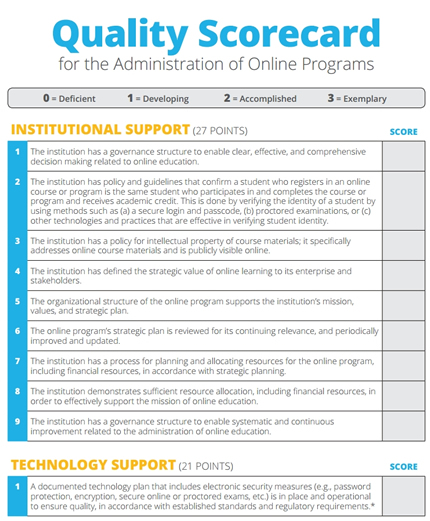
OLC's new Quality Scorecard for Online Programs evaluates courses using 75 indicators to arrive at a score of 0-3. |
|
Users of the quality scorecard cite it as a useful model by which to identify areas of strength and areas for improvement in their online programs.
The School of Information at San Jose State University uses the scorecard to monitor the quality of several online programs, including its master of library and information science, which recently earned an award of excellence from OLC.
"The scorecard provides a helpful framework for strategic planning and is used to evaluate programs, identify areas for change, and reassess annually," said Sandra Hirsh, professor and director at the School of Information.
The State University of New York is using the scorecard as a foundation for internal evaluations of its new online program, Open SUNY. "The goal of the Open SUNY Institutional Readiness program is to systematically increase the capacity of our SUNY campuses to ensure quality and success in online learning," said Alexandra Pickett, associate director of the Open SUNY Center for Excellence in Online Teaching. "We decided to build our Open SUNY [institutional research] process around the OLC quality scorecard because it is a nationally recognized self-assessment tool that is based on vetted standards and effective practices to evaluate and support continuous improvement in online programs."
That process "involves self-assessment at the campus level using the OLC Scorecard, but then goes beyond that to include benchmarking, documenting best practices, and implementation planning for the campus, also based on the scorecard," added Kim Scalzo, director of Open SUNY Campus Partnerships.
Debbie Thorne, associate VP for Academic Affairs and professor of marketing at Texas State University, noted that use of the scorecard helps provide evidence to accreditors of her institution's commitment to improvement. "The quality scorecard is grounded in research, best practices and expert opinion, so I know the university is well-served by implementing the self-assessment process and demonstrating our continuous improvement processes and outcomes to accreditors."
Members of OLC have access to the new scorecard as well as a handbook. However, non-members can register for a free copy of the six-page scorecard itself online at the OLC site.
About the Author
Dian Schaffhauser is a former senior contributing editor for 1105 Media's education publications THE Journal, Campus Technology and Spaces4Learning.