U Colorado Boulder Students To Staff NASA Missions
- By Dian Schaffhauser
- 03/05/15
Students at the University of Colorado Boulder will be working on a mission for NASA scheduled for launch next week and intended to explore geomagnetic storms, solar flares and other energetic phenomena in the atmosphere. The university will host a science operations center for managing a $1.1 billion Magnetospheric Multiscale (MMS) mission, which will consist of four identical, octagonal spacecraft flying in a pyramid formation near the sun and away from the sun.
Each spacecraft will carry 25 instruments for various experiments tied to the study of "magnetic reconnection," where energy is transferred from the solar wind to Earth's magnetosphere, explained Professor and Lead Scientist Daniel Baker. "Magnetic reconnection is a process in which energy stored in a magnetic field is converted, generally explosively, into heat and energy in the form of charged particle acceleration and large-scale flows of hot gas or plasma."
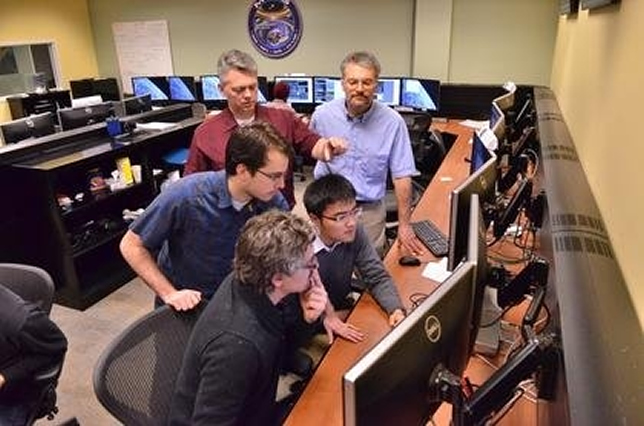
Bill Possel, director of the university's Laboratory for Atmospheric and Space Physics (LASP) mission operations and data systems, added that the data pulled down to earth from the four spacecraft will be captured, stored and distributed from LASP's operations center. "Our job to get it out to scientists as quickly as we can."
The center will also upload commands and monitor the 100 instruments, a "big jump" from the 15 instruments it currently works with, he noted.
About 20 undergraduates — some of whom developed the upload software — will work in four-hour shifts 24 hours a day alongside professionals to monitor the spacecraft during a six-month "checkout" period. After that, the mission is scheduled to continue for another two years.
Aerospace engineering sciences junior Evan Grazer said the students are currently learning how to do their jobs by conducting dry runs. "We are the ones who will be at the consoles, sending instrument commands and working closely with the flight controllers, so we want to learn how to be as effective as possible," he said.
Fellow student Esteben Rodriguez, also a junior in aerospace engineering sciences, said that he "knew about CU-Boulder's reputation in the space sciences." What he didn't know was that "this is one of the few places in the world where undergraduates can get real mission operations experience."
The four vehicles they'll be communicating with will be stacked and flying in formation like "giant pancakes." The instruments they'll carry will produce 3-D images of electron plasma by recording points of data every 30 milliseconds — about 10 times faster than the blink of an eye. The instrumentation will include plasma analyzers, energetic particle detectors, magnetometers and electric fields devices.
However, all of the data can't be sent back to Earth because of the high volume. So the operations people will scan low-resolution data for "'thumbprints' of magnetic reconnection events," said science operations center Manager Chris Pankratz. These are "essentially needles in a haystack." Once they're identified, the spacecraft will be commanded to send down high-resolution data samples."
"We have been waiting for the past 70 years for a 'smoking gun' observation of this magnetic reconnection process," said Baker. "Now we will be able to see electrons and protons move around the magnetic field, and finally observe the mechanisms by which the magnetic reconnection process takes place."
A NASA video on the mission is on the NASA Web site.
About the Author
Dian Schaffhauser is a former senior contributing editor for 1105 Media's education publications THE Journal, Campus Technology and Spaces4Learning.