Sierra College Maker Space Fosters Student Innovation
The community college in suburban Sacramento has partnered with Hacker Lab to give students an opportunity to put to work the academic concepts they learn in their classes.
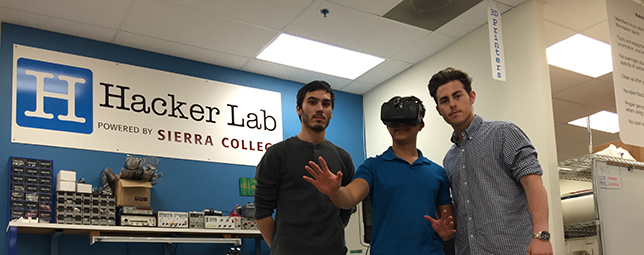
Students from Sierra College are taking advantage of their ability to "make" things at the Hacker Lab.
Sierra College in Rocklin, CA, a suburb of Sacramento, has helped a Hacker Lab open near its campus and has already seen its students start to benefit.
The maker space that also offers co-working space, courses, meet-ups and events is a spin-off of the original Hacker Lab that opened in Sacramento four years ago. Sierra College helped facilitate the opening of the second lab to give both students and those who live nearby the opportunity to get hands-on experience with the technology they are learning back in their community college classrooms.
"It is the best of both worlds," Hacker Lab co-founder Gina Lujan said. "Students benefit from the academic curriculum at Sierra College and bring it to Hacker Lab where they can roam freely and collaborate with the maker community. When open source and crafters collide, it ignites innovation."
By innovation, Lujan could have been referring to the 3D-printed headset and goggles that a user can slip a cell phone into in order to have a virtual reality experience. That's what Sierra students Nick Pham, Ryan O'Malley and Sebastian Romanet came up with just nine days after attending their first virtual reality meet-up at the Lab.
They took their 3D headset and a beta program to run it to a meeting of Silicon Valley investors, who were easily impressed by the three students' early efforts.
"If Hacker Lab didn't exist, that wouldn't have happened," Romanet said.
That kind of innovation is exactly what Carol Pepper-Kittredge, director of the college's Center for Applied Competitive Technologies, hoped would happen. However, even she did not imagine it would happen so quickly, just a few months after the Lab's opening.
"The synergy of industry experts, start-up resources and accessible maker space and tools is powerfully inviting to students and entrepreneurs," Pepper-Kittredge said.
The Lab has a continuous round of meet-ups, start-up support and classes in — for now — industrial sewing, 3D printing, metal fabrication, laser cutting, ShopBot CNB and building mobile apps. Membership — as low as $12.50 a month for students — guarantees access to the maker space 24 hours a day, seven days a week.
"At the grassroots level, the Hacker Lab community is fostering technology that is now in its infancy and will be the norm in the future," Lujan said. "These students are ahead of the curve."
About the Author
Michael Hart is a Los Angeles-based freelance writer and the former executive editor of THE Journal.