East Carolina U Taps Virtual, Mixed Reality to Instruct Future Teachers
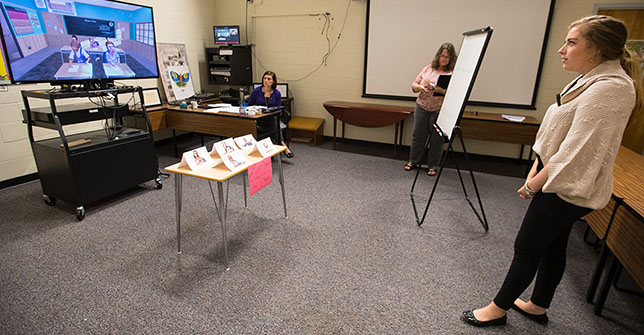
Image Credit: Cliff Hollis, ECU News Services.
East Carolina University (ECU) has become the first of 17 campuses within the University of North Carolina (UNC) system to use virtual and mixed reality to train future K–12 teachers. Students within ECU’s College of Education are currently using a virtual reality program that simulates a typical classroom environment, giving students the opportunity to practice classroom management techniques and instructional strategies.
Last spring, the College of Education launched a pilot program using Mursion, which features a classroom of virtual students that mimic real student behaviors. Mursion works by using a combination of artificial intelligence and live actors to deliver personalized simulations. The student avatars, for example, have a range of personalities, “from the first-to-raise-their-hand to the distracted shy student,” according to a report from ECU News Services.
ECU students do not wear headsets or other devices with the technology, the university told Campus Technology. Instead, students stand in front of a large screen that projects a virtual classroom. They can interact with the avatars, receiving immediate feedback from both peers and instructors. Additionally, the program provides “easy-to-capture analytics that can inform future training plans,” according to the company’s website.
Christine Wilson is the instructional technology consultant, webmaster and Mursion coordinator at the Office of Assessment, Accreditation and Data Management in the ECU College of Education. “We have used role playing situations in the past where fellow students play the role of the K–12 student while another is the teacher,” she explained. “Students who have used both the Mursion technology at ECU and the role play method have found that in Mursion they feel more like they are in an actual classroom or having a meeting with an actual parent. They find it more difficult with their classmates because they know them and have a history with them. Mursion really is as close to getting into a classroom and working with kids or meeting with a parent as one can get without actually being there.”
The Mursion platform is used by more than 65 universities and other programs that prepare K–12 teachers, as well as organizations in health, finance, hospitality and corporate sectors. According to the company’s website, “Mursion delivers customized virtual reality simulations that recreate the most demanding interpersonal challenges that professionals confront on the job every day.”
To learn more, watch the video demonstration below, or visit the ECU News site.
About the Author
Sri Ravipati is Web producer for THE Journal and Campus Technology. She can be reached at [email protected].