Stevens Institute Lab Prepares Business Students for Data-Driven Finance Field
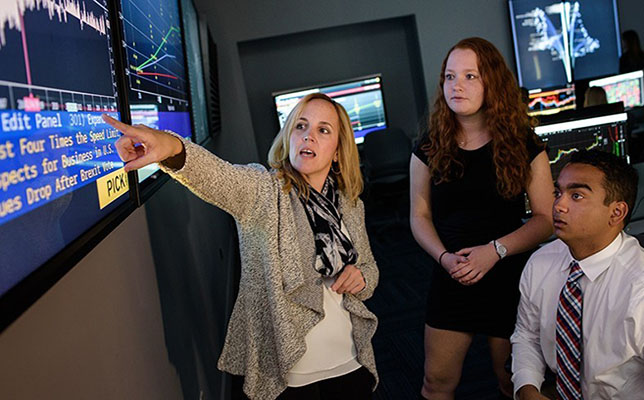
Image Credit: Stevens Institute News.
Ask any C-level business executive and they will likely agree that today’s business world is data-driven. Management must be able to analyze high volumes of data in order to make faster, more informed decisions that accelerate the growth of an enterprise. To better prepare students for future careers in business and finance, the School of Business at Stevens Institute of Technology, a private research university in Hoboken, NJ, is helping undergraduate and graduate students become tech-savvy financial managers with its cutting-edge lab.
Located within the Hanlon Financial Systems Center, the newly opened Hanlon Lab for Analytics and Data Visualization (nicknamed the “Hanlon 2”) puts collaboration tools in the hands of students and researchers.
The Hanlon 2 employs a collaborative design with technology in mind. The $1 million lab is equipped with high-definition cameras and screens, allowing for on- and off-site presentations. Technology like Oblong enables presenters to simultaneously collaborate, whether across campus or across the world, according to a university news report. Using Oblong – which is found on the front end of IBM’s Watson – students can display class assignments from their phone or computer directly to the screens in the lab.
In addition, the lab has more than 20 “workstations” equipped with software from Bloomberg, FactSet, Capital IQ, Morningstar and other industry applications. Students can access real-time Bloomberg data, as well as tools like R, SAS and Hadoop.
“In 20 years, finance has gone from a people-oriented business to a high-tech business,” said George Calhoun, director of the Hanlon Financial Systems Center and of the undergraduate Quantitative Finance program. “The engineering mindset at Stevens is valuable to the financial industry — that’s why they come here and recruit here.”
The center has a strong alumni network and connection with industry experts. At a recent Stevens on the Street networking event, nearly 80 alumni working in finance on Wall Street returned to Stevens Institute to view the lab and provide feedback on student projects.
Data science was ranked No. 1 on Glassdoor’s “25 Best Jobs in America” list this year. Calhoun said in a statement that the “data science revolution is going to change every business model.”
“The ability for managers to extract important signals, and to present them in a way that’s relevant to the decisions companies have to make, will be invaluable in tomorrow’s job market — and our students will be fully prepared,” he said.
To learn more, watch the video report from NJTV News below, or visit the Stevens Institute site.
About the Author
Sri Ravipati is Web producer for THE Journal and Campus Technology. She can be reached at [email protected].