NC State and IBM Build Hub for Quantum Computing Research
North Carolina State University is working with IBM to develop the next generation of workers who have experience with quantum computing.
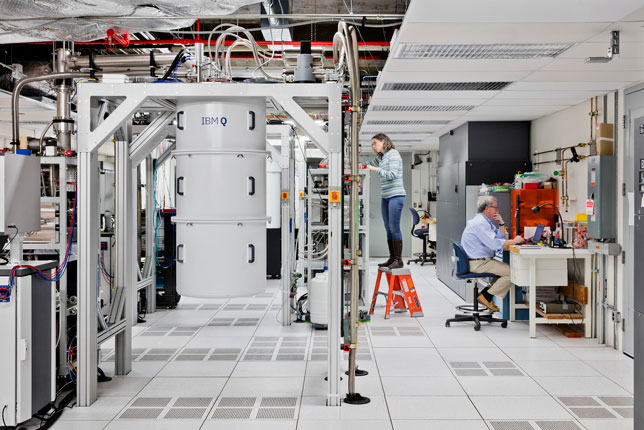
IBM Q
As a leading public research university, North Carolina State University recognized that it wanted to start a program to educate students on quantum computing, but it didn't have the resources to dedicate to build and maintain its own equipment. Last year, NC State announced a partnership with IBM to get early access to the IBM Q commercial quantum computing resources for research purposes. As a result, IBM has created the first university-based IBM Q Hub in North America at NC State.
The IBM Q Network is a collaborative effort by companies, academic institutions and national research labs to further the advancement of quantum computing research. The IBM Q Hub at NC State is focused on educating students through curricula and applied research in addition to pursuing the commercial applications of the technology.
"The students who have access to the machines are already experimenting and working on some early stage programs so they can learn how quantum computing works," said Dennis Kekas, associate vice chancellor for partnerships and economic development at NC State. "The idea is that the young students that are starting their educations will start to work with faculty on research endeavors and become tomorrow's ready workforce to work in these domains as the technology experimentation evolves."
Students and faculty are able to access IBM's quantum computing efforts through remote cloud access where they can gain the ability to do computations. "For a relatively small investment, we have access to these technologies that would be hard to justify funding to support. As part of the deal, we can get deeper technical expertise," said Kekas.
For IBM, the opportunity to work with NC State presented many benefits. The collaboration gives NC State and IBM the ability to take academic work beyond the theoretical, to look into the applications of quantum computing research. "We are taking IBM Q systems technology, putting it in the hands of researchers and working together to develop the foundational understanding to use this technology in the near future for practical purposes," said Anthony Annunziata, IBM Q Network global leader.
While both Kekas and Annunziata acknowledged that quantum computing's potential has not been fully realized, they both expressed an interest in getting students trained on the technology as part of an effort to build a workforce for the in-demand field. Kekas said one of his ultimate aims is that NC State researchers play a part in solving some of quantum computing's biggest challenges. "We are at the beginning of a long journey and we want to train the young minds on this whole new approach to thinking," said Kekas.
IBM and NC State's efforts to expand the field of knowledge and the workforce around quantum computing come at the same time that the federal government is taking a larger look at the technology. In December 2018, Congress passed the National Quantum Initiative Act to promote research through grants from three federal agencies.
The law authorizes $1.2 billion over the next five years for federal activities to boost investment in quantum information science. The National Institute of Standards and Technology directed to establish or expand collaborative ventures or consortia with universities, industry and national labs. The National Science Foundation and the Department of Energy instructed to establish up to five centers for quantum research and education.
While Annunziata wouldn't comment on whether IBM is working with any government agencies, he said that IBM views federal funding from government agencies as critical to ensure that quantum computing succeeds.
When it comes to cross collaborations with other IBM Q Network partners, NC State hopes that the IBM Q Hub will lead to creating a bigger ecosystem where partners in the consortium can share best practices. "We see the IBM Q Hub as a starting point and we intend to work with all of the hubs to learn from each other," said Kekas.
More information about the IBM Q Hub at NC State can be found here.
About the Author
 Sara Friedman is a reporter/producer for Campus Technology, THE Journal and STEAM Universe covering education policy and a wide range of other public-sector IT topics.
Friedman is a graduate of Ithaca College, where she studied journalism, politics and international communications.
Friedman can be contacted at [email protected] or follow her on Twitter @SaraEFriedman.
Click here for previous articles by Friedman.