Education Helping to Drive Surge in AR & VR

Augmented and virtual reality will see massive growth in the next five years, driven in large part by both K–12 and post-secondary education.

According to a new forecast from market research firm IDC, AR and VR will grow at a compound annual growth rate (CAGR) of 78.3 percent for the next five years to reach nearly 10 times the scale it's expected to hit this year — from $16.8 billion in 2019 to $160 billion in 2023.

According to IDC, two of the top five use cases for growth are in the education sector:

  • Lab and field work in higher education, which is expected to grow at a CAGR of 183.4 percent over the forecast period; and

  • Lab and field work in K–12, which is expected to grow at a CAGR of 146.3 percent.
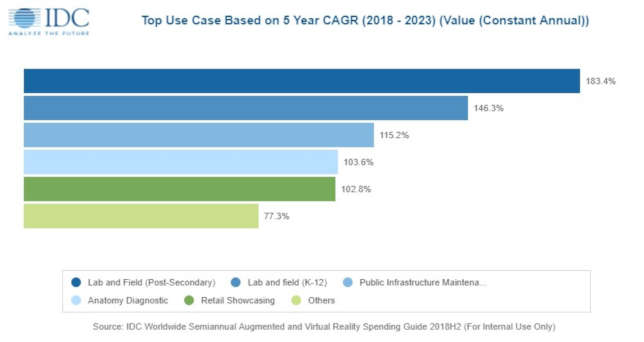
Education Helping to Drive Massive Surge in AR & VR 

The United States will not lead in either spending or growth. China will spend the most on AR and VR technology during the forecast period. The United States will come in second. The two combined will account for about three-quarters of the world’s spending on this technology category.

The fastest growth will be seen in Western Europe, followed by the United States and China.

According to IDC: “Hardware will account for more than half of all AR/VR spending throughout the forecast, followed by software and services. Strong spending growth (189.2 percent CAGR) for AR viewers will make this the largest hardware category by the end of the forecast, followed by VR host devices. AR software will be the second fastest growing category, enabling it to overtake VR software spending by 2022. Services spending will be driven by strong growth from AR consulting services, AR custom application development, and AR systems integration.”

For more information, go to IDC’s Worldwide Semiannual Augmented and Virtual Reality Spending Guide.

About the Author

David Nagel is the former editorial director of 1105 Media's Education Group and editor-in-chief of THE Journal, STEAM Universe, and Spaces4Learning. A 30-year publishing veteran, Nagel has led or contributed to dozens of technology, art, marketing, media, and business publications.

He can be reached at [email protected]. You can also connect with him on LinkedIn at https://www.linkedin.com/in/davidrnagel/ .


Featured

  • artificial intelligence on laptop

    OpenAI to Combine AI Products into Desktop 'Superapp'

    OpenAI is reportedly developing a desktop application that would combine several of its emerging AI products into a single platform, according to reports, marking the latest step in the company's effort to transform ChatGPT from a standalone chatbot into a broader productivity and automation environment.

  • Abstract digital data stream with binary code and colorful light trails

    Microsoft Releases Open Source AI Safety Tools for Agent Development

    Microsoft released RAMPART and Clarity as open-source projects intended to help developers test AI agents earlier in the software lifecycle and turn red-team findings into repeatable engineering checks.

  • abstract illustration of artificial intelligence

    CSU Shares AI Learnings in Systemwide Survey

    In a systemwide survey of more than 94,000 faculty, staff, and students, California State University recently documented widespread AI use across its 22 campuses.

  • Profile silhouette of a person thoughtfully touching their chin, overlaid with transparent data visualizations and digital interface elements suggesting artificial intelligence and analytics.

    The Institutional Knowledge Shift Is Reshaping Higher Ed IT

    Higher education IT leaders are navigating a quiet but consequential transition: Experienced team members are retiring or leaving for private-sector roles, and the teams replacing them are smaller, newer, and often stretched thin. The result is a structural shift in how technology decisions are made, executed, and sustained.