Report: 5 Enrollment Scenarios for Fall 2020
- By Dian Schaffhauser
- 05/18/20
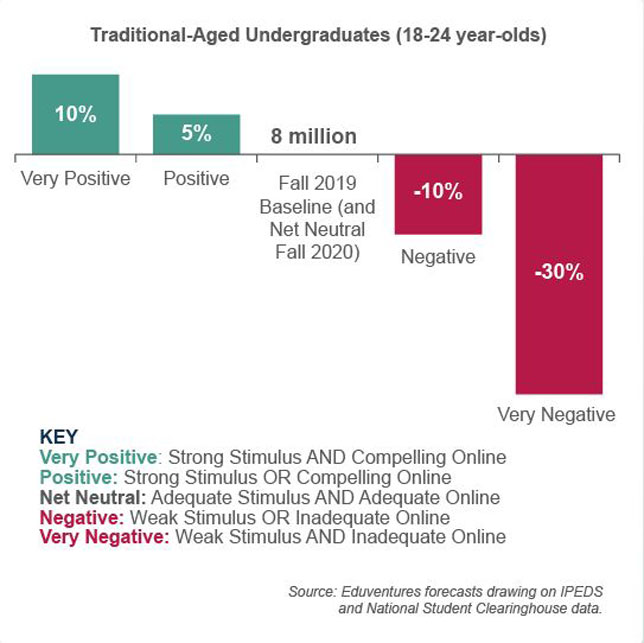
Five fall enrollment scenarios for colleges and universities, from Eduventures
Higher education research firm Eduventures has offered its perspective on the upbeat and disheartening enrollment scenarios possible for fall 2020. On the positive end of the spectrum, enrollment for traditional undergraduates (those between the ages of 18 and 24) could show a 5 to 10 percent increase ("positive" to "very positive") compared to fall 2019. At the negative extreme, there could be up to a 30 percent drop in enrollment. Why such a low high and a high low? Because college participation is already so high among the age group, there's "less room for growth," while there's great capacity to fall.
According to Richard Garrett, Eduventures chief research officer, writing in "Forecasting Five Fall Enrollment Scenarios," the last economic downturn saw undergraduate enrollment rise by about 3 percent in fall 2007 and 2008. As he noted, the Great Recession happened to coincide "with perhaps the largest high school graduating classes in U.S. history, boosting enrollment regardless."
However, the current situation has several variables in play other than demographics: the extent of federal stimulus funding bolstering schools and families; the persistence of the virus; and the quality of the learning experience delivered online.
Should federal subsidies continue "strong enough to match the scale of the downturn," Garrett wrote, families will view school for their college-age students "as welcome continuity and an investment in the future." That's especially true if the jobs usually open to high school graduates don't exist "mid-pandemic." Lacking employment options, more young people might decide to continue their education.
But for that scenario to generate a 10 percent uptick, Garrett added, schools need to build online experiences that justify "standard tuition."
At the other end of the scale, if stimulus doesn't continue, "sickness and anxiety persist" and online schooling doesn't take a dramatic swing for the better, Garrett wrote, "many students and families will defer or look elsewhere." His prediction for almost any scenario is that students will stay closer to home and attend schools that are less expensive, meaning in-state public universities and community colleges.
Garrett also foresees the possibility that fully online schools will do well. "If family finances are really strained, low-priced online course providers, like Straighterline and Outlier, may rise in prominence with students and parents calculating that banking some general education credits may be the best way to ride out the crisis and get a jump on fall 2021," he wrote.
Another "wildcard" that could surface is federal or state introduction of public works programs, Garrett suggested. These would give young people "a productive alternative to college at a time of national need."
The scenarios, openly available on the Encoura website, are part of an Eduventures report, "Fall 2020 Enrollment Scenarios, Part 1: Traditional-Aged Undergraduates," available to NRCCUA members.
About the Author
Dian Schaffhauser is a former senior contributing editor for 1105 Media's education publications THE Journal, Campus Technology and Spaces4Learning.