UC San Diego Shows Off Virtual Reality with Touch
- By Dian Schaffhauser
- 07/22/10
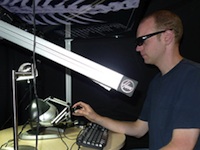
Calit2's Andrew Prudhomme manipulates HUVR's force-feedback controller. |
Researchers at the University of California, San Diego, have cobbled together a virtual reality device using a 3D high definition TV along with a haptic technology that allows users to view 3D images but also touch them. The Heads-Up Virtual Reality device (or HUVR, pronounced "hover") uses a Samsung 3DTV panel HDTV panel intended for home use and selling online for about $2,200 along with a half-silvered mirror to project the image and a special device similar to a game controller that allows the viewer to interact with the image through touch.
This "VR contraption," as one of the scientists refers to it in a video on YouTube, is being built at the UC San Diego division of the California Institute for Telecommunications and Information Technology (Calit2), which created the device with Calit2's Virtual Reality Design Engineer Greg Dawe.
The researchers said that HUVR will be well suited for training and education tasks where the user needs to handle an object without being able to touch it physically--such as a doctor manipulating a 3D image of a person's brain taken from an MRI to understand an abnormality or an archaeologist understanding an artifact too fragile to be handled. What the user is experiencing could also be shared with others over the network, said research scientist Tom DeFanti.
Progenitors of the device date back 30 years to work done by Bell Labs' Ken Knowlton, who experimented with a half-silvered mirror set at an angle in front of telephone operators to allow them to complete calls on a virtual keyboard. HUVR also evolved from Personal Augmented Reality Immersive System (PARIS), a system created 12 years ago by the same researchers working on HUVR and others at the Electronic Visualization Laboratory at th University of Illinois, Chicago. Compared to the latest project, the original PARIS was low-resolution, too big to move, and expensive, according to a university statement. (PARIS has since been updated to exploit newer technologies.)
The challenge in the latest generation of virtual reality is to evolve less expensive but high-quality stereo eyewear that can track with head movement. This component of the project currently sells commercially for between $5,000 and $20,000. As the scientists described it, the polarization used in passive stereo, which is widely available now, won't remain polarized when reflected off a mirror. However, active stereo generates separate left- and right-eye images that can bounce off mirrors and are separated into left- and right-eye views by the user's active eyewear, which blink in synch with the 3D HDTV's 120 Hz images.
The research and development of the project is supported by Saudi Arabia's King Abdullah University of Science and Technology, as well as funding from the Calit2 Strategic Research Opportunities Program.
About the Author
Dian Schaffhauser is a former senior contributing editor for 1105 Media's education publications THE Journal, Campus Technology and Spaces4Learning.