Carnegie Mellon CIO: "Deep Collaboration" Key to Higher Ed Transformation
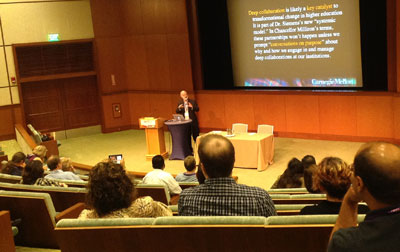
Joel Smith, CIO of Carnegie Mellon University, delivered the closing keynote at Campus Technology 2012 yesterday in Boston. |
Is improving the effectiveness of education a more difficult task than discovering the Higgs boson particle? Joel Smith thinks perhaps it is. The vice provost and chief information officer of Carnegie Mellon University argues that realizing technology’s potential in transforming education will require rethinking the nature of traditional relationships in a very complex and rapidly changing campus environment.
“We seek to be collaborative in higher education, but there are some real barriers,” Smith said in delivering the closing keynote speech of the Campus Technology 2012 conference yesterday in Boston. “We are structured into academic and administrative silos, and we’ve all experienced the roadblocks that hierarchical administrative structures and bureaucracy introduce,” he said, noting that traditional higher ed institutions tend to encourage and reward only individual work. He believes that IT leaders need to embrace what he calls “deep collaboration,” which can be a catalyst in transforming higher education and bending the cost curve of quickly rising tuition and fee charges.
Smith framed his keynote talk as a response to the two other keynotes at the conference, delivered by Mark Milliron, chancellor of Western Governors University Texas, and George Siemens, associate director of the Technology Enhanced Knowledge Research Institute at Athabasca University. Milliron spoke about learning-centered education and how technology can make a radical difference in instruction to help people change their lives. Rather than fighting old battles of online vs. on the ground, universities need to work on merging the two approaches, he said. “What is the way to deploy online tools to tune the blend to increase learning outcomes? Can we use technology to make the human moments more precious?”
Siemens tried to put the changes buffeting higher education into historical perspective by explaining the transformation of earlier industries by new technologies, such as the steam engine, the electrification of America, and the introduction of the iPod. He explained that universities’ value has come from the integration of many services for end users. But we are rapidly moving toward a system that is open, accessible, distributed, scalable, social, networked, and self-organized, he said, and that is a threat to the traditional model of higher education.
Although it’s not clear how education delivery is going to evolve, the whole techno-economic model will change, Siemens said. Elite research universities will not go away, he predicted, and community colleges will have some exciting opportunities. “But the mass in the middle will face significant challenges and are most at risk from the constellation of change pressures.”
Noting that the other two keynotes looked at big-picture visions of change, Smith referred to the three keynote speakers as “two strategists and one plumber.”
“I am a plumber,” he said. “I worry about what we need to do tomorrow to get to where they are talking about.” Smith used his experience collaborating on the Carnegie Mellon Open Learning Initiative (OLI) as an example of the potential partnerships between IT and academia. The project has brought together people with expertise in cognitive and learning sciences, content experts, design experts, software engineers, assessment experts, and students. “We had to find a way for all these people to work together,” Smith said, “and it was not easy.”
From his experience, Smith said, deep collaborations need to address several questions upfront:
- What shared goal are we aligning around?
- What specific expertise is each team member bringing to the collaboration?
- What are the decision-making procedures? (The expert in an area could have the final say or all decisions could require consensus of the whole group.)
- By what methods will we assess progress toward goals and status of the partnership? (Daily maintenance may be required.)
- How will credit and rewards be given? (Academics are typically rewarded for publishing research work, not collaborations on campus.)
Was it worth all the extra work? Smith says yes. Statistical studies have shown that students in blended OLI statistics courses do just as well as students in traditional classroom settings. “IT leaders can be advocates for these type of collaborations that will allow us to achieve the visions Milliron and Siemens talked about,” he said. Developments such as OLI can be translated to other settings and reused. “I submit that reusing what others have done is the only way we can bend that cost curve.”
About the Author
David Raths is a Philadelphia-based freelance writer focused on information technology. He writes regularly for several IT publications, including Healthcare Innovation and Government Technology.