2004 'Hot' Buttons in Higher Ed Technology
IT and academic leaders reveal what keeps them up at night—and what d'esn’t.
In the spring of 2004, a Syllabus2004 Executive Summit* survey of 52 higher
education IT executives and professionals (director level and above) revealed
the most pressing issues their institutions face in the administration of campus
technology programs (see chart, right). Study participants represented medium-sized
private institutions (29%), large publics (23%), medium-sized publics/state
schools (19%), small privates (17%), and community colleges (12%) from the West
Coast (44.5%), Midwest (33%), East Coast, and Southeast (22%), and Canada (.5%).
Respondents titles were predominantly: Director-IT (23%), CIO (15%), Director-Academic/Instructional
(12%), and VP/Vice Provost-IT (10%). Below, key highlights of the study, in
priority order.
| Hot Issue for 2004 |
Ranked High/Highest
Importance by % of Respondents |
| 1. Course Management Systems |
27% |
| 2. Network Security/Privacy |
23% |
| 3. Budgeting/Infrastructure Replacement |
13% |
| 4. ePortfolios/Student Assessment |
11% |
| 5. Portal Technologies/eServices |
9% |
| 6. Enterprise Resource Planning |
8% |
| 7. Mobile/Wireless/Broadband |
8% |
| 8. Cost of Content/Publishing |
1% |
- If CMS is so popular, why do so few faculty use it? While
93 percent of colleges buy commercial CMS, only about 30 percent of their
faculty use them to teach. Despite their acceptance, the systems aren’t
delivering the promised transformation of teaching and learning because of
non-use.
- Steep prices from CMS market leaders anger customers.
Price and scalability are the two top factors considered in the purchase of
a CMS, but steep price increases from the major vendors have angered campus
IT leadership. Said one participant: “At this point, we feel like we’re
being hijacked.”
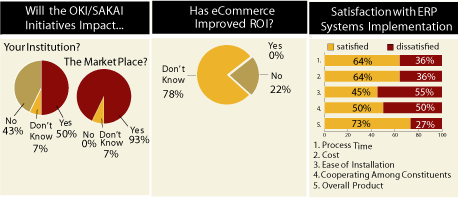
- Open source community initiatives like Sakai offer software options
and leverage against CMS vendor pricing. Even though Sakai community
source software is just coming onto the public market, participants suspect
it is already having an impact in the boardrooms of commercial CMS vendors.
- Denial of service and theft of data top security worries.
No one’s data is as secure as it should be. Some colleges report stopping
hundreds of DoS events and hacks daily.
- Will security hamper academic openness? Some may confuse
protecting information and network operations with constraints on academic
freedom, but participants’ comments reflect that they are acknowledging
security issues: “Realities about openness are changing in the academic
world.”
- Portals and eServices still elusive. Participants say
the promise of portals and eServices is unfulfilled. Providing single sign-on,
role-based access, interoperability, and links to administrative systems are
among the issues of concern. What’s more, institutions don’t know
if their eCommerce solutions yield a positive return on investment.
- Ubiquitous wireless is appearing faster than expected.
Last year, participants estimated it would be five to seven years before their campuses
had full wireless coverage. This year, that estimate bumped up to three to
five years.
- Underwhelmed by ERP. ERP took a backseat to most of the
areas studied, surprising, considering the dissatisfaction with the implementation
of these pricey, enterprise-level systems.
*Adapted from the Syllabus2004 Executive Summit Survey Report, “IT
Issues and Strategic Viewpoints in Higher Education,” July 18, 2004.