Stats
Are You Satisfied?
The IMS Global Learning Consortium spots learning technology satisfaction and trends.
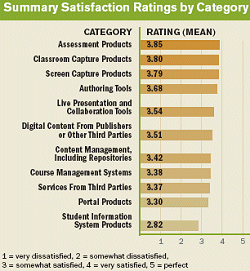
Product categories relevant to course delivery and course management systems
(CMS)—assessment, capture, authoring, presentation and collaboration, digital
content, and CMS—rated higher for satisfaction than other learning technology
services, portals, and most notably, student information systems.
Source: IMS GLC Learning Technology Satisfaction and Trends, 2007.
THE IMS GLOBAL LEARNING CONSORTIUM released the latest report in its ongoing
study of “Learning Technology Satisfaction and Trends”
in February, based on responses from about 200 leaders of
internet-supported learning initiatives in North American
higher education. The report is issued in different versions
for the public, respondents, and IMS members and subscribers.
Access to the public report and summary rankings
can be found here.
While IMS views the research as still being “in its infancy
and preliminary,” and has the intention of evolving the
study over time, the organization has presented some
intriguing trend data from the past year.
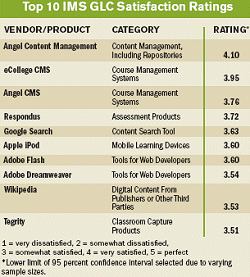
The IMS GLC study cuts across a wide spectrum of technologies that support
or enable learning at higher education institutions, so the “top ten” vendor/
product ratings include a mix of technologies, from course management
systems (CMS) and mobile learning devices, to content search tools.
Source: IMS GLC Learning Technology Satisfaction and Trends, 2007.
The IMS GLC study tracks satisfaction both for general
product categories and for particular vendors and product
offerings. Some product categories ancillary to course management
systems (CMS)—such as capture, authoring, and
digital content—were rated higher for satisfaction than the
CMS category itself, suggesting a strong interest in interactivity
and rich media content. Among the CMS, eCollege, Angel Learning, and Moodle (not in the top ten, with a rating of 3.43) were rated higher for satisfaction than either
market leader Blackboard (rating: 2.97)
or its WebCT property (rating: 2.87). The report pointed to the
appearance of high ratings for Google,
Wikipedia, and Apple’s iPod, “indicating that non-education-specific technologies
are being perceived, by those that incorporate them, as
adding value to the educational experience.”
Editor’s note: IMS Global Learning Consortium CEO Rob Abel
will present “What Is the Learning Impact of the Technology-
Empowered Education You Deliver?” at Campus Technology
2007 in Washington, DC, July 30-Aug. 2.