2008 Campus Technology Innovators: Enhanced Learning/ Assessment
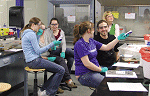
THE USE OF CLICKERS and other tools at WPI has improved efficiency of laboratory
teaching, freeing up instructor time for pedagogical interactions with students.
TECHNOLOGY AREA: ENHANCED LEARNING/ASSESSMENT
Innovator: Worcester Polytechnic Institute
Employing a constellation of technologies, technologists
and educators take laboratory learning and student
performance assessment to new heights, creating a
single 'community' of student scientists.
Technology has not only enriched learning in laboratory classes
at Worcester Polytechnic Institute (MA), it has enabled
educators to better assess student performance. As part of a
recent overhaul (technically, still underway), WPI technologists
turned to Web 2.0 and other tools to enhance the learning
environment in science courses, making content more
relevant to the experience and learning modes of students.
These technologies also have been used to assess, reinforce,
and supplement student learning. Kate Beverage, WPI
instructional technology specialist, says the injection of IT has
modernized the curriculum so dramatically, many students feel
as if the classes are entirely new.
"The electronic nature of the new approach [has] allowed
students access to information and pre-demonstrations of lab
concepts, procedures, and large data sets for analysis and
interpretation," she says. "It truly has changed everything."
The transformation began with a pilot program early this
year, when two labs in anatomy and physical biology classes
needed a jump-start. According to Beverage, increased student
enrollment meant it was becoming more and more difficult
for WPI educators to assess the level of student
understanding in laboratory science courses. With the majority
of lab time devoted to setup and execution of experiments,
data collection and analysis were not receiving the same
emphasis. Beverage adds that many students did not get the
time to focus on whether the data they were collecting reflected
their expected outcomes.
At the behest of project lead Jill Rulfs, associate professor
and director of the Biology and Biotechnology department,
and Laboratory Instructor Michael Buckholt, technology
changed everything. Starting in January 2007, technologists
applied digital media and communication technologies such
as wikis and podcasts from Learning Objects, which were used to enhance the learning
environment. Students also were able to log in to the
school's Blackboard course management
system to gain access to information, demonstrations,
and data sets they couldn't access previously.
WPI students now feel
like working scientists,
collaborating with
colleagues and building
concepts based on data.
Later, Camtasia Studio from TechSmith enabled synchronous and asynchronous exchanges of
information among students, creating a veritable community
of scientists. Instructors could follow individual contributions
to group work and provide feedback and remediation on a
basis more immediate than waiting to see lab reports. What's
more, instructors say the clicker-style Classroom Performance
System from eInstruction has revolutionized
the way they give pre-quizzes.
Other technologies utilized include Microsoft SharePoint
and Office, a Wacom Graphire Wireless
pen tablet, an HP data video projector
and TC4200 tablet PC, and six desktop
PCs from Dell.
So far, Rulfs and Buckholt report that early results of these
new additions have been positive. For students, the new
technology has provided a sense that they are working scientists-- learning procedures, carrying out protocols, collaborating with colleagues, and building concepts based on data. For
educators, the capacity to share pre-lab demonstrations has
improved efficiency of laboratory teaching, freeing up instructor
time that can then be devoted to pedagogical interactions with
individual students.
Some of the benefits weren't even expected. Beverage
says that delivering pre-lab questions with the Classroom Performance
System has provided teachers with several surprise
teaching and learning opportunities. In the past, pre-quizzes
were given on paper, but not graded until after the lab. Deploying
questions with the clicker software allows students to
obtain immediate feedback and correct any pre-lab misinterpretations
or misunderstandings concerning the lab, prior to
conducting the experiment.
During the upcoming school year, Beverage says the methods
used in the biology and biotechnology courses will be implemented
on a broader scale in other laboratory-based science
courses. Rulfs and Buckholt also hope to submit a grant proposal
to the National Science Foundation, in
order to include podcasts, wikis, and other available technologies
in both teaching and project-based laboratories. Furthermore,
like all of the best scientists, the educators intend to
publish their findings from the project, and share their experiences
with colleagues teaching other laboratory-based courses.