CT at the Show
Campus Technology '08 Moves to Convention Center for Record Turnout
Welcome to Next-Gen.Edu!
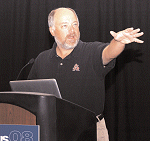 TRAILBLAZER KEYNOTE. No one could better represent Next-Gen.Edu
and set the tone for the Campus Technology
'08 summer conference than opening keynote
Adrian Sannier, Arizona State University's outspoken
senior VP and university technology
officer. Drawing from his ambitious work (with
ASU President Michael Crow) to build the
"New American University," Sannier fired up
the audience of 861 attendees from 496
institutions to pare back to "core" T&L tech
competencies and "get someone bigger and
smarter" to do the rest!
TRAILBLAZER KEYNOTE. No one could better represent Next-Gen.Edu
and set the tone for the Campus Technology
'08 summer conference than opening keynote
Adrian Sannier, Arizona State University's outspoken
senior VP and university technology
officer. Drawing from his ambitious work (with
ASU President Michael Crow) to build the
"New American University," Sannier fired up
the audience of 861 attendees from 496
institutions to pare back to "core" T&L tech
competencies and "get someone bigger and
smarter" to do the rest!
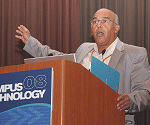 MIT WELCOME: A VISION FOR
OPEN EDUCATION. As a welcome and preview for
the pre-conference tours of MIT's high-tech learning spaces and
initiatives, all pre-conference attendees were treated to a plenary
talk by MIT Office of Educational Innovation and Technology
Director Vijay Kumar.
MIT WELCOME: A VISION FOR
OPEN EDUCATION. As a welcome and preview for
the pre-conference tours of MIT's high-tech learning spaces and
initiatives, all pre-conference attendees were treated to a plenary
talk by MIT Office of Educational Innovation and Technology
Director Vijay Kumar.
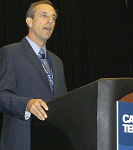 MODEL INNOVATOR. To set
the stage for Campus Technology Editor-in-Chief
Kathy Grayson's recognition of the 2008 Campus
Technology Innovators at the Wednesday morning
general session, Montclair State University (NJ)
VP of IT Ed Chapel reflected on innovations at
his own university. (Chapel and Montclair State
were 2007 Innovator award winners.) The awards
presentation moved on to deliver 14 mini case
studies teeming with fresh campus tech ideas
for attendees.
MODEL INNOVATOR. To set
the stage for Campus Technology Editor-in-Chief
Kathy Grayson's recognition of the 2008 Campus
Technology Innovators at the Wednesday morning
general session, Montclair State University (NJ)
VP of IT Ed Chapel reflected on innovations at
his own university. (Chapel and Montclair State
were 2007 Innovator award winners.) The awards
presentation moved on to deliver 14 mini case
studies teeming with fresh campus tech ideas
for attendees.

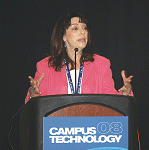
MYTH OR MANDATE? CT Ed-in-Chief Kathy Grayson (standing)
took the podium to moderate the closing general session, "Shootout! Bracing
for the Next-Gen Student Wave." Grayson led a high-powered panel through
questions based on a research presentation by Project Tomorrow CEO Julie Evans (photo, right)-- all to uncover whether or not our campuses
are ready for next-gen students. The interactive session involved the attendees in
controversial discussions and incorporated audience polling technology by Turning
Technologies. Panelists (above): At far left,
David Miller, University of Connecticut; Alicia Russell, Northeastern University (MA). To the right of Grayson: Julie Evans; Anne Moore, Virginia Tech; Steve
Acker, Ohio Board of Regents; and Jim Maraviglia, Cal Poly San Luis Obispo.
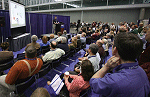
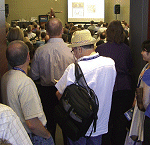 MIT STANDING ROOM ONLY. This
year's track sessions were long on the latest Web 2.0
tools, trends, and analyses, underlying our theme of
Next-Gen.Edu. Sessions in five tracks-- 21st Century
Classroom, Web 2.0, .Edu Application Walk-Thrus, CT
Innovators, and .Edu Infrastructure-- were filled to
capacity. SRO for latecomers highlighted the wisdom
of pre-registering for sessions. Pictured: David Miller's
session on classroom, pre-, and post-podcasting at
the University of Connecticut.
MIT STANDING ROOM ONLY. This
year's track sessions were long on the latest Web 2.0
tools, trends, and analyses, underlying our theme of
Next-Gen.Edu. Sessions in five tracks-- 21st Century
Classroom, Web 2.0, .Edu Application Walk-Thrus, CT
Innovators, and .Edu Infrastructure-- were filled to
capacity. SRO for latecomers highlighted the wisdom
of pre-registering for sessions. Pictured: David Miller's
session on classroom, pre-, and post-podcasting at
the University of Connecticut.
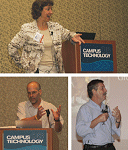 WINNING WORKSHOPS. Several
pre-conference workshops focused on technologies
and strategies to help attendees leverage the best of
Web 2.0 and next-gen collaboration technologies for
their institutions. A sample (clockwise, from top):
Bethany Bovard of New Mexico State University led
jam-packed sessions of attendees in live, hands-on
use of the latest Web 2.0 tools; Georgia College &
State University's Jim Wolfgang discussed unleashing
innovation using collaboration technologies; and Washington
State University's Gary Brown considered the
role of "worldware" in student success.
WINNING WORKSHOPS. Several
pre-conference workshops focused on technologies
and strategies to help attendees leverage the best of
Web 2.0 and next-gen collaboration technologies for
their institutions. A sample (clockwise, from top):
Bethany Bovard of New Mexico State University led
jam-packed sessions of attendees in live, hands-on
use of the latest Web 2.0 tools; Georgia College &
State University's Jim Wolfgang discussed unleashing
innovation using collaboration technologies; and Washington
State University's Gary Brown considered the
role of "worldware" in student success.
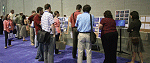
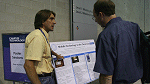
PACKED POSTERS. Poster sessions gave
attendees highly personalized session content experiences
along with great networking possibilities. This year, many
poster presenters elected to supplement their presentations
with laptop demonstrations-- the perfect complement
to posted content.
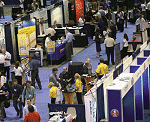
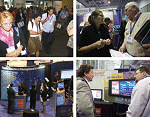
EXHILARATING EXHIBITS.
Attendees flocked to more than 100 vendor
exhibits in the Boston Convention and Exhibition
Center exhibit hall. Conference registrants
enjoyed plenty of time for one-on-one demos and
short-list queries; vendors appreciated the high
level of attendee qualification.
 PRESENTATION THEATER. A series of indepth
technology "walk-thrus" by vendors made the Presentation
Theater in the exhibit hall a key destination for those browsing
the exhibits. Attendees enjoyed the latest product information,
helpful tips, and Q&A with exhibitors. Pictured: TechSmith's Camtasia
Studio.
PRESENTATION THEATER. A series of indepth
technology "walk-thrus" by vendors made the Presentation
Theater in the exhibit hall a key destination for those browsing
the exhibits. Attendees enjoyed the latest product information,
helpful tips, and Q&A with exhibitors. Pictured: TechSmith's Camtasia
Studio.
Editor's note: Conference proceedings and session recordings are
available here. And save
the date: Next year's conference will again return to the Boston
Convention and Exhibition Center July 27-30.