Turning the Page on Print
As a tech magazine with a tech readership, the time for digital is now.
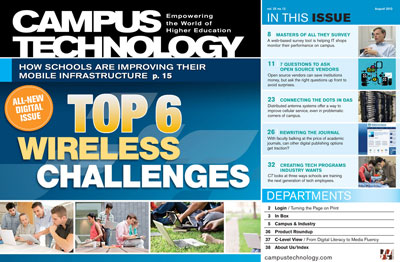
Campus Technology's all-digital August issue |
If not us, then who? That's certainly the way I look at our decision to move to an all-digital publication. We are, after all, a tech magazine with a tech readership. It's time for all of us to walk the walk.
It's a decision that makes even more sense when you consider why we got into this field in the first place--to improve education. For years, CT has championed efforts to use technology to pull higher education into the 21st century, whether it's innovative e-texts or anytime, anywhere learning opportunities. Yet, each month, we felled a few trees and smeared them with ink to tell you about these trends. That's like the dentist telling you to lay off the candy while he stuffs gummy bears into his maw. We needed to make the change--for our own credibility and because it's the right thing to do.
Many of you face a similar situation. How many of you are still struggling to convince faculty of the benefits of educational technology? How many of you still struggle to secure buy-in from campus leaders? If you expect students and faculty to embrace educational technologies, you too need to lead by example. Reading a digital CT may seem like a small step, but small steps can take you a long, long way.
As an editor, I'm particularly excited about the flexibility that an all-digital format gives us. If you've ever tried to write about certain aspects of technology--configurable classrooms, for example--you know that, if a picture is worth a thousand words, a short video is worth a book. Our ability to incorporate multimedia--video, slideshows, and audio--means that we can now do a better job of helping you make the decisions that will move your institution forward.
And if we can't provide you with all the information you need, we can seamlessly link you to a resource that can--our magazine will no longer be a walled garden. With collaboration the hottest topic in education today, we needed to give our readers ways to continue the discussions started in our articles via Twitter, Facebook, and more.
From my perspective at least, our move to digital meshes perfectly with how my own reading habits have changed over the last couple of years. Unless I am languishing in a doctor's office, I have almost completely given up print magazines. And it's been years since I read an ink newspaper, preferring to read newspapers online from around the world. And that's just for my personal information needs. For work, I can't remember the last time I read something in print.
Judging by the proliferation of tablets on the laps of conference attendees at CT 2012, I would wager that most of you obtain information for your job in the same way that I do. By going digital, CT is moving the conversation to where you work--and making it richer. Ultimately, I hope our new digital publication can help you blaze the trail toward a brighter future for higher education.
About the Author
Andrew Barbour is the former executive editor of Campus Technology.