Kingston Debuts 1 TB External Flash Drive
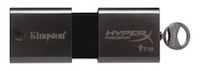
The Kingston DataTraveler HyperX Predator 3.0 offers capacities of up to 1 TB and read speeds of up to 240 MBps.

At the 2013 International CES event in Las Vegas, Kingston Digital unveiled a new line of USB 3.0 flash drives with capacities up to 1 terabyte, the largest to date.

The new line, the DataTraveler HyperX Predator 3.0, supports both USB 2.0 and USB 3.0, offering write speeds of up to 160 MB per second and read speeds of up to 240 MBps with a USB 3.0 host controller (30 MBps read/write using a USB 2.0 host controller). The devices will be available in two configurations--512 GB, available now, and 1 TB, available within the next three months.

The new models measure about 2.8" (length without the key ring) x 1.1" x 0.8".

In related news, Kingston also started shipping lower-capacity flash drives in its DataTraveler Ultimate 3.0 Generation 3 line, including a 32 GB model and a 64 GB model. Both support USB 3.0 and offer read speeds of up to 150 MBps and write speeds of 70 MBps (30 MBps read and 20 MBps write using USB 2.0). The DataTraveler Ultimate 3.0 G3 models measure about 2.7" (length without key ring) x 0.9" x 0.46".

The DataTraveler HyperX Predator 3.0 supports both USB 3.0 and USB 2.0 on Mac OS X (10.6 or greater), Windows (XP SP3 or newer), and Linux (kernel 2.6.31 or greater). The 512 GB version is shipping now. It's listed at $1,337 in Kingston's online shop. The 1 TB version will ship later this quarter. Both include a five-year warranty. The DataTraveler Ultimate 3.0 G3 starts at $62. Those units come with a three-year warranty.

Additional details about the DataTraveler HyperX Predator 3.0 and DataTraveler Ultimate 3.0 G3 can be found on Kingston's site.

About the Author

David Nagel is the former editorial director of 1105 Media's Education Group and editor-in-chief of THE Journal, STEAM Universe, and Spaces4Learning. A 30-year publishing veteran, Nagel has led or contributed to dozens of technology, art, marketing, media, and business publications.

He can be reached at [email protected]. You can also connect with him on LinkedIn at https://www.linkedin.com/in/davidrnagel/ .


Featured

  • stylized illustration of people conversing on headsets

    AI and Our Next Conversations in Higher Education

    Ryan Lufkin, the vice president of global strategy for Instructure, examines how the focus on AI in education will move from experimentation to accountability.

  • AI word on microchip and colorful light spread

    Microsoft Unveils Maia 200 Inference Chip to Cut AI Serving Costs

    Microsoft recently introduced Maia 200, a custom-built accelerator aimed at lowering the cost of running artificial intelligence workloads at cloud scale, as major providers look to curb soaring inference expenses and lessen dependence on Nvidia graphics processors.

  • large group of college students sitting on an academic quad

    Student Readiness: Learning to Learn

    Melissa Loble, Instructure's chief academic officer, recommends a focus on 'readiness' as a broader concept as we try to understand how to build meaningful education experiences that can form a bridge from the university to the workplace. Here, we ask Loble what readiness is and how to offer students the ability to 'learn to learn'.

  • Blue metallic mesh fabric folds

    Microsoft Acquires Osmos for Agentic AI Data Engineering

    In a strategic move to reduce time-consuming manual data preparation, Microsoft has acquired Seattle-based startup Osmos, specializing in agentic AI for data engineering.