Metaverse Org Declares the Technology Is Accelerating in Spite of Rise of AI
A new report from the Metaverse Standards Forum (MSF) declares the technology initiative is alive and well, despite skyrocketing attention paid to artificial intelligence.
"The term 'metaverse' has weathered a significant hype cycle, where inconsistent definitions led to confusion and premature declarations of its demise," the MSF said in its annual report. "The surge in AI interest has further complicated the narrative, with some suggesting AI has superseded the metaverse as a transformative technology."
The company Meta, formerly Facebook, is the driving force behind the metaverse, which it announced in 2021 as a set of interconnected digital spaces where people can socialize, work, and play in immersive, 3D environments. The following year, the MSF formed to foster cooperation and collaboration among organizations to create open standards for the development and operation of the initiative. While Meta was a founding member of the MSF, the organization is independent and not controlled by Meta. ChatGPT provided this comparison of the two:
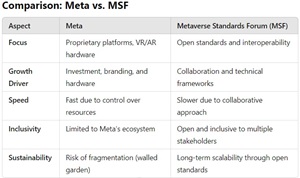 [Click on image for larger view.] Meta and MSF (source: ChatGPT).
The MSF decried any notions of the metaverse being superseded by AI (see the April 2024 article, "Remember the Metaverse? Now It's 'AI and the Metaverse'").
The MSF said that within the context of its definition of the metaverse — the convergence of web connectivity with spatial computing — activity is actually accelerating even in the face of game-changing AI.
"AI serves as an enabler, enhancing metaverse capabilities, while the metaverse will often provide a natural interface for AI interactions and agents," the MSF said. "The Forum will intensify its efforts to show how AI and the metaverse are interconnected technologies that enhance and amplify each other."
For its part, the head of Meta's Reality Labs arm weighed in on the issue in a December blog post, "Accelerating the Future: AI, Mixed Reality and the Metaverse" where Orion augmented reality (AR) glasses and mixed-reality hardware were featured prominently.
"As the number of people in MR grows, the quality of the social experience it can deliver is growing in tandem," said Andrew Bosworth, the CTO of Reality Labs, in last month's post. "This is at the heart of what Meta is trying to achieve with Reality Labs and where the greatest potential of the metaverse will be unlocked: 'the chance to create the most social platform ever' is how we described it when we first began working on it."
The MSF, meanwhile, is forging ahead even in the face of many failed projects that it noted in its annual report.
"While the term 'metaverse' may currently carry baggage from its hype cycle, the underlying technological convergence it represents remains vibrant and growing," the MSF said. "Until a more precise term emerges, the Forum will continue to focus on educating the industry about the concrete and significant capabilities being developed, rather than debating the term itself.
"While the late 2021 surge in metaverse interest sparked numerous initiatives — many of which have since ceased — the Forum remains focused on strengthening its industry relevance through a unique approach: concentrating on pre- and post-standardization activities for the emerging immersive web. Rather than debating theoretical long-term roadmaps, the Forum encourages the natural member-driven evolution of pragmatic projects that create immediate business opportunities through growing interoperability."
Read the full report on the MSF site here.
About the Author
David Ramel is an editor and writer at Converge 360.