Student Readiness: Learning to Learn
A Q&A with Melissa Loble, Instructure's CAO
It's not a new problem. Over the years, higher education leaders have asked themselves whether students' academic careers prepare them for the job market and future employment. These concerns about a knowledge gap or a skills gap have taken many forms, often appearing alongside discussions of competency-based learning, learning outcomes, or personalized learning.
Melissa Loble, chief academic officer at Instructure, has worked in higher education for 24 years, teaching online and keenly observing student knowledge gaps or skills gaps, especially through studies she's conducted or participated in during the past five years. She recommends a focus on 'readiness' as a broader concept as we try to understand how to build meaningful education experiences that can form a bridge from the university to the workplace. Here, we ask Loble what readiness is and how to offer students the ability to 'learn to learn'.
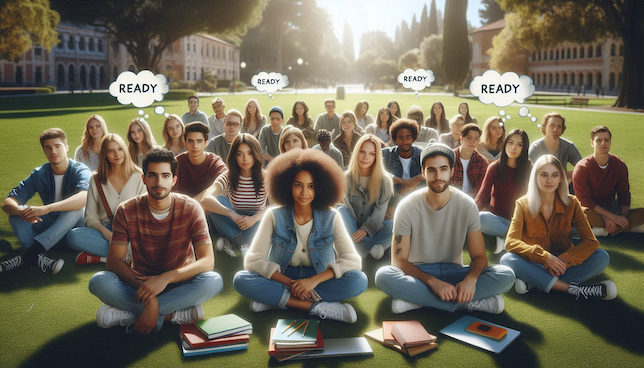 Technology drives change. 'Learning to learn' drives readiness. (Image by AI: Microsoft Image Creator by Designer.)
Mary Grush: Is there a 'readiness gap' experienced by college or university students or graduates entering or just approaching the job market? How would you characterize it? Do students perceive this gap along with industry employers and higher education program leadership?
Melissa Loble: Yes, we do see a readiness gap. And what we mean by readiness is having the skills needed to be successful in today's working and learning environments, which are changing more rapidly than they have in the past.
For example, a concrete readiness skill would be resilience: the ability, as things change, to learn, adapt, and work through that change.
Another example of readiness would be possessing appropriate technology skills for your job. I wouldn't necessarily point to specific technology skills, like how to use an Excel spreadsheet if you're in accounting, but I'd examine, more generally, how to identify, adopt, and understand relevant technologies for the job, and how to apply digital literacy, such as staying safe in the ways you use technology.
A third example would be understanding yourself as a learner — the ability to teach yourself the technical and professional skills needed for your job, along with necessary communications skills and an understanding of the culture of that job.
Those are all examples of readiness.
And yes, students themselves are saying that they feel they're not ready. They don't feel there are enough low-stakes opportunities to practice the skills they're going to be using when they leave higher education and enter the workforce. So students are saying they don't have enough opportunities to prepare and practice their readiness skills.
Across the board, from our higher education programs, to industry employers, and to students, we're all seeing skills gaps. And frankly most of us are missing the mark on skill development.
So we're all seeing the gaps, and we all need to work to find different and productive partnership-oriented ways to address those gaps. There's no one particular part of the education cycle that should be held responsible or needs to be somehow accountable. It's everybody's responsibility.
Grush: Is there a clear-cut distinction between readiness and the perspective earned from the core curriculum of a liberal education?
Loble: I don't think they're one and the same, but I think there are a lot of underpinnings to a liberal education that are about readiness and can be called upon to address readiness.
There are a lot of underpinnings to a liberal education that are about readiness and can be called upon to address readiness.
So there is an overlap there. From my perspective, a traditional liberal education does a fair amount of this readiness work. And in my experience, the more we see alternative programs surface where some of that traditional liberal education isn't a part of it, that is when we have concerns about how ready students will become.
So to answer your question simply, readiness skill development and a liberal education are not one and the same, but there's definitely significant crossover between the two.
Grush: What are some of the conversations looking like, among education and industry leaders, that might attempt to guide partnerships and programs that support readiness?
Loble: So far, there is not enough conversation among K12, higher education, and industry around what the meaningful paths are and how we should be ensuring that individual students and learners get the right combination of technical or discipline-specific skills along with all the appropriate readiness skills.
We see a lot these days of industry saying, "We have job descriptions… We have taxonomies for skills…" But that's not enough. Even with these taxonomies and job descriptions, that's not getting at what it takes for someone to be successful, or in fact, to thrive with readiness.
And how do we create opportunities for people to grow once they have entered their professions? There are just not enough focused conversations right now, that would connect academia and industry in promoting readiness.
Grush: Who would take the initiative to start the kind of conversations needed?
Loble: In some situations, the academic institutions will initiate the conversation.
I've seen instances of that kind of initiative. For example, I sit on the Cal State University AI Acceleration Board. We've brought faculty, students, education leadership, industry leaders, and some government officials onto the board. And we're all having a deep discussion around what it takes, specifically in an AI world, for students to be ready as they enter the workforce.
Those kinds of discussions need to happen, and as I've mentioned, there's just not enough of them. And when some different groups do sit down together it can be more of a one-sided exchange: Industry says, "Well, let me tell you what I want". And then education is supposed to respond. Or vice versa. This type of conversation needs, instead, to be a dialogue, talking about where the gaps are coming from and why they are getting bigger.
And the more we focus primarily on technical skills and discipline-specific skills, the greater the chance we could miss the overall readiness skills that we need people to have. We need to lean back in on the true partnership aspects of these kinds of shared conversations and promote dialogue and collaboration — not just outlining what each of us wants and throwing that over the fence.
We should be working together. If we work in our silos, everybody ends up finger-pointing at each other. And as I've said, it's not that one part of education or training is at fault… it just needs to change.
Arizona State University is a really good example of taking a type of initiative that's more collaborative; more productive. They do a lot of industry-aligned programs and partnerships, but those aren't merely building highly specific skills. They're also building a broader readiness.
They are concerned with how students and those new to the job market learn resilience and how to adapt — and how people can identify growth opportunities for themselves. The work at ASU is just one example; there are many others.
Middle Tennessee State University is another institution that does similar work in which they partner with industry. They've initiated outreach, and while part of it is about specific job skills, it's both that and readiness skills combined.
Sometimes you'll see industry initiate a dialogue, particularly in areas, or states, or regions where they have lots of job opportunities that may go unfilled. They have tailored programs for local employees focusing on the kinds of skills they need for available jobs. So with industry, it's likely to be an economic need, and workforce needs are going to be a big part of that.
I think there are going to be places where industry will say, "I need to work with higher education because I can't train new employees the way I want. I need to reskill and upskill them. So I'm going to lean on higher ed".
Finally, an initial part of our dialogues may be seen as consumer needs — with students as the consumers. They may not be so much "taking the initiative" as simply creating some pressure. Learners are going to say, "I need these kinds of programs. I need to be prepared to go do this". And they're going to look to higher education for that expertise.
So I think dialogue will come from multiple directions, really just depending on the time and place and what's needed for particular communities.
Grush: I can remember long ago when hiring a recent graduate meant bringing the latest thinking into your company. Is that even possible today? Given the rate of change in the information and knowledge context, would it be possible or even ethical for institutions to market their graduate cohorts in that way?
Loble: I don't know if it would be considered marketing in 'the latest knowledge' context, but what higher education could certainly aim to market is that students are coming into the workforce prepared for change, prepared with those readiness skills that we've talked about, and understanding themselves as learners so they can adapt and learn quickly. Ideally their readiness for change and their resilience will produce positive approaches throughout times of change.
They will be prepared to analyze technology and make good choices for themselves around what kinds of technology to use, and where — say, for just one example, from a privacy perspective. So I think there is ample reason to believe that higher education institutions can absolutely market their students to industry with skills that are going to be needed in this world of rapidly building change.
Grush: There are many kinds of employers, so it's hard to generalize any one thing in this realm. But do you think commercial companies are likely to contribute to cooperative efforts or to studies that might approach potential universal solutions?
Loble: I think they will participate, and they are ready to be good collaborators — but maybe not in universal studies. Rather, I think, companies will be more willing to participate in industry-specific studies.
As an example, let's look at something discipline-specific: financial services. I could see financial services companies being willing to participate in studies to understand what drives success with their employees in those companies and what underlying skills are needed for that. I could see them participating with business goals, or information science goals, or things like that.
I think it will be either the discipline-specific nature of initiatives, or it's going to be that there are regional considerations involved in order to move commercial companies to participate. But I do think that companies will be willing, in their industry or in their community, or both, to engage in those kinds of projects or studies.
Grush: Let's talk about certificates in higher education for a bit. Is it possible to design approaches that may mitigate skills gaps with certifications on basic levels while at the same time being able to blend those certificates into existing, established credentialing practices at higher education institutions — all without interruption?
Will the idea of stackable credentials fit easily with more traditional, existing education program models?
Loble: I think that's going to happen, though not easily. There will need to be some program analysis done to discover return on investment.
For traditional programs, such as undergraduate or graduate degree programs, stacking credentials that are already seeing some value is really powerful. For example, a communications major might also get a certificate in AI.
Certificates are often more skill-driven, or even discipline-specific skill-driven. Pulling them into a broader, liberal education and being able to marry certificates with a traditional liberal education is doable — and in fact has already been done at a number of institutions. Where I think higher education will struggle a little bit, is going to be with certain issues around stackable credentials: How do you ensure that by simply stacking, you don't miss some of those broader readiness skills? And how do you know you won't miss the structure and commitment of a whole degree program?
So I think yes, you can stack some of the more traditional or well-established programs with certificates alongside them to build a unique learner, a future employee who's got a broad education along with demonstrable skills specific for the discipline. I think where it will be harder for education — but they will be able to do it — is purely stacking credentials, one on top of another, and making sure there's continuity and meaning across them. Institutions will have to teach themselves how to do that.
Grush: Thinking back on the question of who initiates conversations or programs around readiness, I'm wondering: Is there a role for alumni or even for lifelong learners?
Loble: I don't see enough of alumni organizations being leveraged to inform what should be taught in higher education programs. There is a great group of people that could get involved and help institutions understand the reality of the workforce. And that idea extends to all lifelong learners.
Alumni and lifelong learners in general can also use their bridge back to the workforce to remind people in industry what's happening in higher education and why to be involved. Alumni and lifelong learners are a great resource, especially if you can offer them their own learning opportunities through their involvement.
Of course, there are some purely practical and time management issues involved at this point: Most of us are just going through our day-to-day commitments, and simply getting things done. We're not all stopping to think about the potential of these alumni and lifelong learner groups. But that could change over time.
Grush: What are the main factors that will propel us toward readiness over time?
Loble: Taking a long view of technology and society, we can see that technology has been and still is the rapid change agent that puts institutions under pressure — though not necessarily in a bad way — to rethink two things: one, how important process is, versus outcome; and two, how important technology literacy is.
We can see evidence all around us, of why process versus outcome is rising in importance and in our consciousness. AI in particular, is showing us this right now. What we're realizing is, we are going to be working in some sort of augmented world where it's humans and AI coming together and doing work in some way, shape, or form.
And in that, if we're preparing students for that world, we need to see their process, not just their final product. So we're seeing a lot of institutions start to talk about shifting assessment away from one big final high-stakes exam to ongoing assignments and activities where it's not just about the answer — but we want to see how the student got to that answer and how they used, or might have used, technology to get to that answer. So I think this emphasis of process as opposed to final output is rapidly changing how we prepare — and that's where higher education is going to continue to iterate and leverage technology.
And then similarly, I think AI has also brought a renewed desire for literacy, but it's not just AI literacy. It's actually technology literacy, and in fact it's even more than that: It's readiness. We have for so long in education and even in the workforce not thought enough about how we prepare people to learn and how we prepare them to make good decisions for themselves around the tools that they use.
Right now the focus is on both how we train faculty, and how we train students. How do we help everyone understand AI? But it's more than AI. It's a new movement around how we help people understand how to use technology and be prepared. It's how to have readiness. So I think that's where we'll see a good future, long term, as it merges both of these things together: process as opposed to outcomes and the need for literacy.
Grush: And ultimately, technology drives change; while learning to learn moves us toward readiness…?
Loble: Yes. Readiness will be supported by learning to learn, and technology will continue to drive the kind of change that will be experienced throughout the learner's journey.